

Reporters from various member countries of the Common Market for Eastern and Southern Africa (Comesa) Competition Commission (CCC) gathered in Livingstone, Zambia, for the second regional workshop for business reporters. This was a follow-up to the first such workshop organised last October at the same venue.
The aim of the workshop was to educate the journalists on the role and importance of competition of the Comesa Competition Commission in a market economy and how its enforcement activities further such goals.
It was also to increase their awareness of its regulations, provisions and its operations, as well as the developments pertaining to the trade agenda within the region and the continent, of which all state members, Seychelles being one, have to adhere to.
In attendance were reporters from Malawi, Zimbabwe, Zambia, Uganda, Swaziland, Mauritius, the Congo, Kenya and Seychelles.
The Commission is responsible, among other things, for promoting competition and enhancing the welfare of consumers in the common market. The main functions of the Commission are to prohibit, monitor and investigate anti-competitive business practices, control mergers and other forms of acquisitions in the common market and mediate disputes between the member states concerning anti-competitive conduct. The Commission started its operations on January 14, 2013 and is located in Lilongwe, Malawi.
High officials of the commission made presentations on the rules, regulations, laws and policies of the Commission. Among the prominent speakers were the director and chief executive Georges Lipimile; Hon. Prof Justice Samuel Rugege, Judge of the Comesa Court of Justice which resolves trade disputes between member states; the chairperson of CCC board of commissioners, Matthews Chikankheni; Gabriel Masuku, legal affairs officer in the Legal and Institutional Affairs Division of the Comesa Secretariat; Willard Mwemba, manager mergers & acquisitions; Mary Gurure, manager, legal services & compliance.
In his presentation, Mr Lipimile emphasised the importance of competition law within the common market.
“Competition promotes innovation as firms facing competitive rivals innovate more than monopolies. The purpose of competition law is to facilitate competitive markets, so as to promote economic efficiency, thereby generate lower prices, 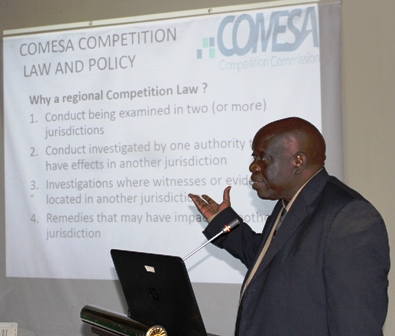 increase choice and economic growth and thus enhance the welfare of the general community,” Mr Lipimile said.
increase choice and economic growth and thus enhance the welfare of the general community,” Mr Lipimile said.
Mr Chikankheni said competition policy by its nature is more than enforcement – it is a way of organising the member states’ economy. Competition policy is a form of regulation that competes with other regulatory regimes, many of which are not friendly to free markets.
In this regard, he added, competition policy must become more aggressive in competing with other forms of regulations.
“We, as competition advocates should, therefore, support a competition mass movement at every opportunity or forum. This is where the critical role of the media comes in,” he said.
Mr Chikankheni also emphasised the important role of competition enforcement. He also remarked that this is why the Comesa Competition Commission remains committed to aggressive enforcement of the Comesa Competition Regulations while taking into consideration that enforcement is not the only tool available as there are other better or more effective tools to achieving the same goal especially where dealing with policy makers is concerned.
When talking on merger regulations in the common market, Mr Mwemba said they are an important aspect in ensuring that the single market agenda is realised. He said one of the ways in which a single market is realised is through the elimination of barriers to trade like the traditional tariff and non-tariff barriers to trade.
“However, if certain mergers are left unchecked, they can create more barriers to trade than those already dismantled through the trade policy,” stressed Mr Mwemba while remarking on the need for a merger to be lodged with the CCC after thirty days of conception.
Talking on the Comesa institutional framework, Mr Masuku explained its main legal instruments which are the treaty establishing Comesa; the protocols which is, for example, on the free movement of persons; regulations like the instruments of customs union and directives.
He also highlighted the organs of the Comesa which are the authority, the council of ministers, the court of justice, the committee of governors of central banks, intergovernmental committees, the secretariat and the consultative committee.
The speakers also touched on the newly established Tripartite Free Trade Area (PTA) which was signed on June 10, 2015 at the Egyptian holiday resort town of Sharm el Sheikh. The aim of the agreement is to spur investments in Africa and create jobs to achieve important public policy objectives including poverty eradication. It is made up of 26 countries but the agreement has been signed by sixteen of them so far.


0 comments :
Post a Comment