
Parliament and media seek to better understand each other’s roles
17-July-2014
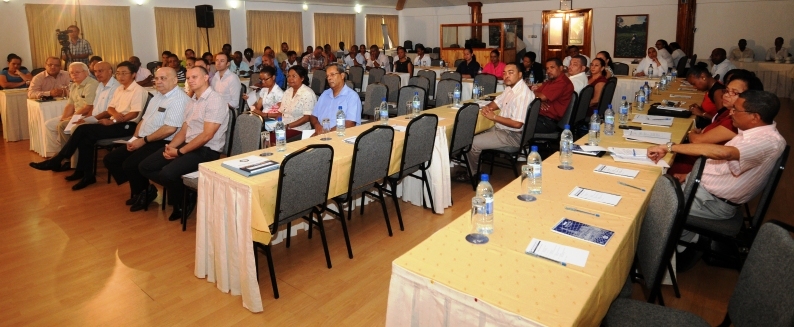
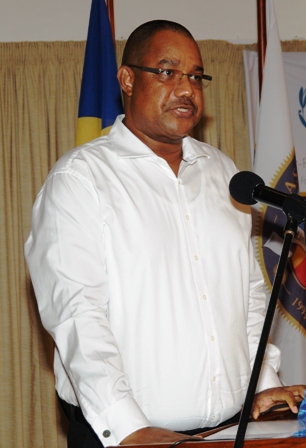 Members of the National Assembly and of the different media houses have come together to discuss and understand better each other’s role.
This is being done through a two-day seminar organised in collaboration with the Inter-Parliamentary Union (IPU) and the National Assembly of Seychelles. The seminar, being held at the Seychelles Trading Company’s conference hall, was officially opened yesterday by the Speaker of the National Assembly Dr Patrick Herminie in the presence of the Minister for Foreign Affairs Jean-Paul Adam; the leader of the opposition in the Assembly David Pierre and IPU representative Japhet Muthomi.
In his opening remarks, Dr Herminie said that the media is one of parliament’s most crucial co-partners in enabling the public’s enjoyment of their right to know and the furtherance of human rights.
“Their presence is without a doubt vital for a functioning democracy and in the quest for good governance,” said Dr Herminie.
Dr Herminie noted that the National Assembly of the Third Republic has over 20 years been established as the forum where the social, cultural, economic and political concerns and views of the Seychellois people are brought to the fore and the media is encouraged to educate and keep the public informed of parliamentary activities and the role of parliament in the empowerment of the people, thereby sustaining our vibrant democracy.
“While the National Assembly remains obliged to the traditional and social media in raising its profile, both nationally and internationally, I also feel that it is high time that the institution develops its own capacity to transmit its deliberations, hence the urgent need for our own broadcasting unit,” said Dr Herminie.
He added that while it is true that parliament and parliamentarians, as representatives of the people, possess ultimate legitimacy, it is as equally true that the media plays a decisive role in shaping public opinion.
“It is the media after all which assists the community in their decision by providing the public with information about the actions and opinions of parliamentarians,” noted Dr Herminie.
Ibrahim Afif, chairperson of the Seychelles Media Commission, noted that in a democracy there are four pillars: the Executive, the Judiciary and the Legislative designed to be independent of each other in the exercise of power, the fourth being the Media which has to act as informer and guardian of the people to make the elected accountable to the electorate.
Noting that this role is a huge responsibility fraught with innumerable challenges, Mr Afif said the workshop presents an opportunity to examine carefully the role of each and how to maintain a professional and healthy relationship with neither side trying to bully the other.
“Neither side should regard each other as enemies. Each one will try to protect its own turf but this should not be at the expense of objectivity, truth and fairness that the public has a right to expect,” Mr Afif said, adding we would fail the public totally if the relationship between the media and parliament became so warm cosy to the point of being in bed together.
“Journalists should try to understand the standpoints of parliamentarians and equally parliamentarians must get to appreciate the rules that govern journalistic styles and methods. Media has a crucial role to play. It is a responsibility that the Media has to discharge conscientiously, responsibly, objectively with due regard to the truth, accuracy, balance and fairness. All very laudable objectives, but often we fail to live up to these standards,” Mr Afif added.
For his part Mr Muthomi noted that the nature of parliamentary representation is changing compared with 50 years ago and parliaments are more open and accessible, more professionally run, better-resourced, and more representative.
“One lesson that parliaments have learned from their efforts to engage citizens is the following: you cannot wait for the people to come to parliament; you need to go where the people are. And one means of doing this is through the various media channels available,” Mr Muthomi explained.
He added that the challenge for parliament is that conflict is far more interesting and entertaining than consensus, noting that in many countries it appears that there is a lack of trust between politicians and journalists and the result is often a poor and distorted impression of politicians.
“The hope is through this workshop both parliamentarians and journalists will have a better understanding of each other’s roles with the aim of providing balanced information on the work of parliament and ultimately improving the public understanding and participation in parliament work,” said Mr Muthomi.
Some of the topics discussed during the workshop include the role and functioning of the National Assembly: its communications strategy, role of social media and tools; balanced and responsible reporting on parliament and politics; parliamentarians, media and citizens – shared needs, different interest; building relations and communicating with the media; develop and refine existing communication plan for parliament; strategic planning for the National Assembly of Seychelles.
Claire Doole, former BBC correspondent, was invited to conduct some of the sessions.


0 comments :
Post a Comment