Monday, September 30, 2013

Seychelles welcomes Security Council Resolution on Syria

Seychelles welcomes Security Council Resolution on Syria

30.09.2013
Seychelles welcomes the adoption of a binding resolution on the removal and destruction of chemical weapons in Syria which was agreed by the Security Council last night in New York, Minister Jean-Paul Adam has stated.

Speaking from New York where the Minister is accompanying Vice President Danny
Faure at the 68th Session of the United Nations General Assembly, the Minister reiterated Seychelles' view with regards to the importance of finding a solution both to the question of the chemical weapons in Syria and the ongoing conflict.

"This Security Council Resolution represents a real step forward towards not only ridding Syria of chemical weapons in accordance with international conventions, but also to create momentum for an end to hostilities in Syria.  Seychelles has consistently emphasized the importance of engagement through UN processes towards ending the conflict which has claimed too many lives."

Seychelles had spoken in condemnation of the use of chemical weapons in Syria through a statement by Permanent Representative to the UN, Marie-Louise Potter, on 17th September after the presentation of the UN Secretary General's report on the use of chemical weapons on 21st August.  In her statement Seychelles had called for the appropriate UN Security Council resolution to follow the report, and for UN processes to be prioritized with regards to finding a long term solution to the crisis.

Friday, September 27, 2013

Seychelles Honoured with ‘African Development Excellence Award’ in New York

Seychelles Honoured with ‘African Development Excellence Award’ in New York

26.09.2013
President James Michel has been conferred with the ‘African Development Excellence Award’ during the African Investment and Development Awards Ceremony held in New York to coincide with the holding of the United Nations General Assembly.
The award, presented yesterday evening, was collected by Vice President Danny Faure on behalf of President Michel and the people of Seychelles.
The Award was presented by Dr. Ken Giami, the CEO of African Leadership Magazine and founder of the Centre for economic and Leadership Development, an NGO with consultative status with the United Nations Economic and Social Council (ECOSOC).
President Michel conveyed the following message through the Vice President on the occasion of the ceremony:
"I am deeply honored to receive the African Development Excellence award. I accept it on behalf of the people of Seychelles and I dedicate it to them. I consider the con ferment of this prestigious award as recognition of our achievements as one of the best governed countries in Africa, stemming from the hard work and commitment we have put in a human centered approach to development."
In his keynote remarks on the occasion of the ceremony, the Vice President shared some of Seychelles experiences in terms of development, and economic reforms that helped transform the Seychelles economy in 2008.  He also highlighted Seychelles confidence in the power of intra-African investment as a driver of development.  He noted the positive trends in terms of African tourism and stated that Seychelles is committed towards enhancing Africa's potential in terms of tourism development through the African Union.
In terms of future perspectives, the Vice President stressed that sustainable development must be embraced as an opportunity for African nations.  He cited renewable energy and the potential of the blue economy as being catalysts for the development of Seychelles, as well as the wider region.
The Vice President also stated that while Seychelles was a small state, it had shown that it could make a big contribution, and was thus also positioning itself for a bid for a non-permanent seat of the UN Security Council for the year 2017- 2018:
"While we are a small nation- we believe that all voices count.  Our experiences in establishing viable maritime security provides a template for wider international cooperation in stabilizing our region and we look forward to strengthening our contribution through this bid."
The Vice President said that Seychelles small size could be a source of strength rather than weakness, and that Seychelles was determined to ensure this was the case.
"We are the smallest nation in Africa, but we are determined to ensure that our small size is not a weakness but a strength.  Our flexibility, our unity of purpose, and our development of a harmonious and united society have given us tools that have allowed us to continue to progress, and ensure that we sustain the political will for often difficult governance decisions."

Wednesday, September 25, 2013

PTC Express service

PTC Express service


16-September-2013
The Seychelles Public Transport Corporation (SPTC) is always improving its services to the public. The company is in constant collaboration with all the district administrations and listens to suggestions from members of the public to better the public transport system.
Recently, SPTC has introduced new bus schedules on various routes to cater for such demands and suggestions. It must be noted that the company not just puts into practice what everyone says, they also undertake visits on respective sites and the decisions taken to either put another service on certain roads are based also on road conditions, demands and topography of the land.
Among the new services recently introduced are Shuttle, Express, extra buses or amended time of service to various districts.
(More under LIVING Menu)

Manage your money

Manage your money


16-September-2013
Many people worry about their finances and often it is all too easy to ignore the situation in the hope that things get better. The reality is that in the long term this is only likely to make things worse. Worrying about money can lead to other problems like stress and anxiety.
If you are worrying about money, there are a number of easy steps you can take to help you get things back on track. (More under LIVING Menu).

Konsiltasyon lo lentrodiksyon en lasirans pour fermye ek peser i demare

Konsiltasyon lo lentrodiksyon en lasirans pour fermye ek peser i demare


25-September-2013
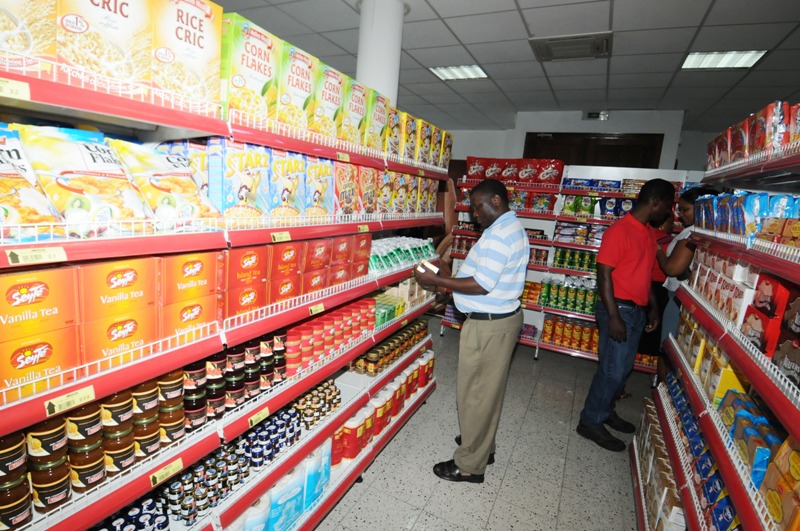
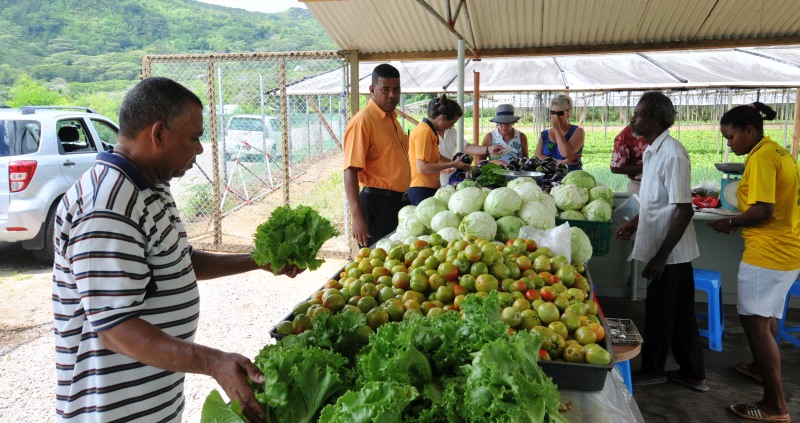
Minister Resours Natirel in komans en seri miting pour donn bann fermye plis leksplikasyon e osi ganny zot pwennvi lo en plan lasirans pour fermye ek peser ki ekspekte lanse osito ki tou bann detay i fini finalize.

Premye dan sa seri miting ti fer yer kot biro ladministrasyon distrik Anse Boileau e fermye sorti enpe partou dan rezyon Sid, Les ek Was Mahé ti asiste.

Se Minis pour Resours Natirel Peter Sinon ki pe diriz sa bann miting ansanm avek sef egzekitif Lazans Lagrikiltir Marc Naiken, bann zofisye ek teknisyen lagrikiltir osi byen ki reprezantan lakonpannyen lasirans SACOS ek H. Savy Insurance. 

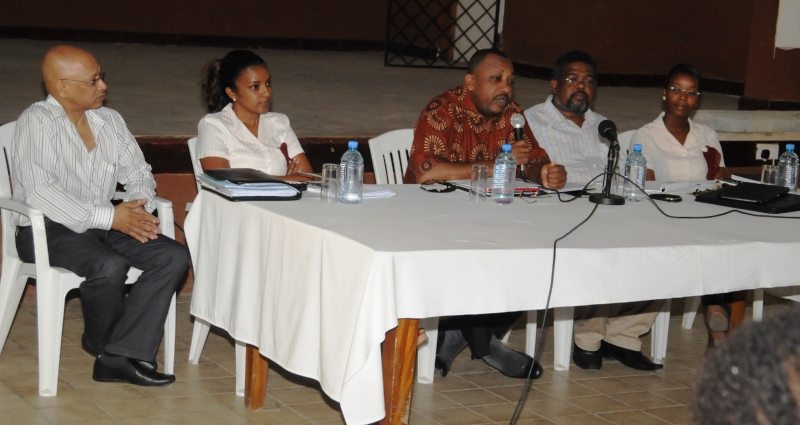
Me pour sa premye miting yer zis bann reprezantan SACOS ki ti prezan pour donn leksplikasyon e reponn kestyon e klarifye konsern bann fermye.

Letan i ti adres bann fermye, Minis Sinon ti dir ki i kontan ki finalman apre en kantite diskisyon ek konsiltasyon avek plizyer parti konsernen lo sa size, ozordi sa plan lasirans in vin konkret e son minister in arive annan en dokiman pour prezant avek fermye pour zot donn zot pwennvi e rod plis leklersisman lo la avan i vin final.

I ti fer remarke ki dezas ki ti frap bann distrik sirtou dan Les Mahé boner sa lannen in fer nou realize ki nou bezwen finaliz keksoz e bouz pli vit.

«Apre sa dezas e avek tou bann rapor ki ti’n annan lo sa size, tou bann partener konsernen in regroupe pour vwar kwa ki kapab al dan en package ki nou krwar ki fermye i kapab soutenir e osi kont lo la pour ganny en rekonpans pour rekonmanse apre ki in annan en dezas e zot bann prodwi in ganny afekte,» Minis Sinon ti dir.

«En lasirans i meyer fason pour fer sa me menm si lasirans i en biznes ziska prezan pa’n annan enn pour fermye ek peser e sa i akoz son risk ki i anmennen i tro gran e gouvernman in bezwen entervenir pour kapab fer ki sa lasirans i vin en opsyon vyab e dan benefis bann fermye,»  Minis Sinon ti eksplike.

Bann fermye ti ganny bokou leksplikasyon lo ki fason sa lasirans pou marse
.
Sa plan lasirans pour lagrikiltir in ganny drafte pour donn proteksyon fermye apre en deklarasyon ofisyel koze par en dezas natirel. I mandatwar pour tou fermye ki travay aplentan pour anrezistre avek Lazans Lagrikiltir (SAA) pour zot kapab benefisye anba sa plan. SAA i sa lazans ki pou administre sa lasirans e i pou sa pwen kontak pour bann fermye e i pou asire ki i annan lenformasyon azour lo sak fermye anrezistre.

Sa lasirans i annan 3 konponan ki i kouver e sa i bann plant, zannimo ek aksidan avek sa fermye.

Kot i konsern bann plant, lasirans pou pey bann claim ki plis ki 20% valer total bann prodwi ki an risk par sa dezas. Pour zannimo, sa lasirans pou pey pour bann pert ki plis ki 10% valer total bann zannimo ki an risk.

An sa ki konsern aksidan avek sa fermye, li i pou bezwen asir en sonm 100 mil roupi. Met laferm avek son fanmir osi byen ki son bann travayer aplentan ou par sezon zot osi ganny kouver ler zot pe travay lo laferm selman.

Sa bann claim pou selman valid ler gouvernman i fer en deklarasyon dezas e sa fermye i bezwen averti SAA avan 48 erdtan.

An sa ki konsern kou sa lasirans, 4% sa sonm total lo valer total plant/zannimo, ladan 50% pou ganny peye par gouvernman.
Sa lasirans pou ganny revize apre 3-an.

Fodre dir ki bann fermye ti annan bokou kestyon lo sa size e bokou ti fer resorti ki i annan dezas ki afekte bann fermye e ki pa en dezas nasyonal e ki fodre sak ka i ganny egzaminen dan en fason endividyel, ki lezot keksoz parey lenfrastriktir ek lekipman i devret osi ganny kouver, parmi plizyer lezot pwen ankor. Tousala Minis Sinon ek bann zofisye SACOS ti reponn e donn leksplikasyon.

Sa bann miting i kontinyen ozordi avek fermye Val d’Andorre, demen English River e le 2 Oktob pour fermye Praslin ek La Digue e sa pou fer dan sant kominoter Grand Anse.
Antretan, Lotorite Lapes Sesel (SFA) i osi ekspekte organiz bann miting parey pour bann peser.
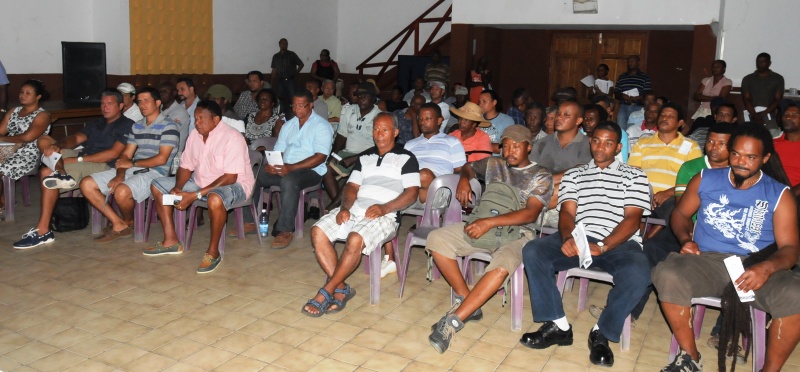
Miting yer avek bann fermye dan rezyon sid, les ek was Mahé

Seychelles shares experiences on disability inclusive development in the context of the MDGs

Seychelles shares experiences on disability inclusive development in the context of the MDGs

24.09.2013
The Seychelles delegation attending the UNGA has emphasised the need for inclusion of persons with disabilities as key component of sustainable development, stressing, “Sustainability implies responsibilities for all as well as opportunities for all”.
Foreign Minister Jean-Paul Adam delivered the statement at the High level Meeting of the General Assembly on the Realisation of the Millennium Development Goals and other Internationally Agreed Development Goals for Persons with Disabilities under the theme ‘The way forward: a disability-inclusive development agenda towards 2015 and beyond’ on Monday.
The event was held as a pre-cursor of the opening of the United Nations General Assembly which opens on Tuesday 24th September.  Vice President Danny Faure is currently representing President James Michel at the General Assembly and is leading the Seychelles delegation.
In the statement, the Minister has also emphasised the importance of reinforcing education and skills development of persons with disabilities as well the need to provide support for families:
“In small societies such as Seychelles, by strengthening the support to the family, we can also strengthen inclusion of those family members living with disabilities.  Strong families mean strong societies.”

Monday, September 23, 2013

Seychelles Expresses Solidarity with Kenya During Attack on Shopping Mall

Seychelles Expresses Solidarity with Kenya During Attack on Shopping Mall

22.09.2013
President James Michel has expressed his profound sadness and sincere condolences to the People and Government of Kenya following the ongoing attack on Westgate shopping centre in Nairobi that has resulted in the mass injuries and the loss of countless lives.
The President condemned the attack and extended the support of the People and Government of Seychelles, as well as the families of those affected around the world, in a letter sent to President Uhuru Kenyatta:
“We consider this attack as an assault on the values of freedom and tolerance that Seychelles and Kenya share, and we condemn it in the strongest terms.
The Seychellois people join me in expressing to you our most heartfelt condolences. Our thoughts and prayers are with the victims and their families.”
President Michel also spoke of the need for continued action in bringing stability to region:
“As Kenya's security forces continue to do their utmost to secure the site, we offer our solidarity and express our unreserved support in the face of this atrocity committed not only against the Kenyan people- but against the whole East African region.
We also stand with you in emphasizing that such attacks further strengthen our resolve to stand firm in our efforts to secure peace and stability throughout the Horn of Africa.”

Monday, September 16, 2013

UniSey’s wetland project gets a boost

UniSey’s wetland project gets a boost


16-September-2013
As part of the BSc Environmental Science training at the University of Seychelles, students benefit from practical experience in addressing wetland issues using scientific and systematic approaches. Students enjoy hands-on experience, using specialist equipment deployed with due precision in a controlled working environment.

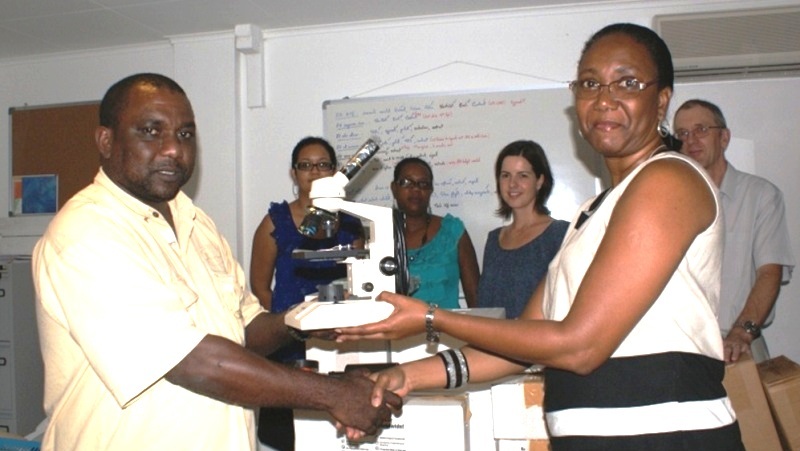
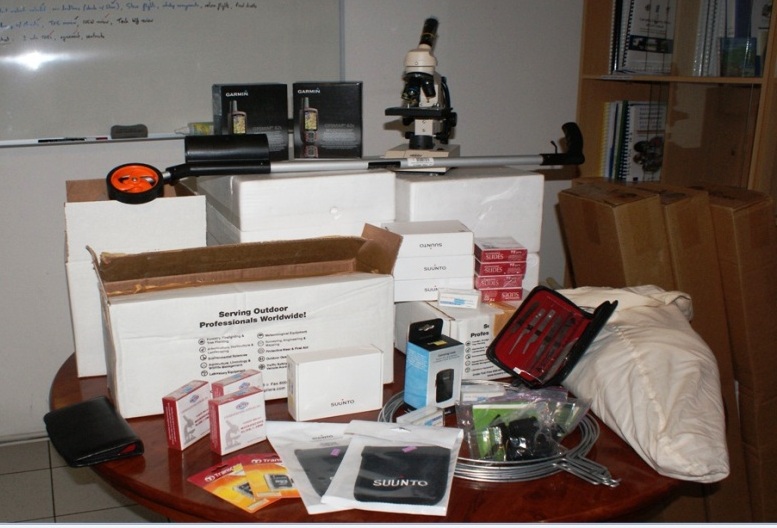
During a ceremony held at the GOS/UNDP/GEF office at Les Palmes building last week, UNDP programme manager for Mauritius and Seychelles Roland Alcindor, presented a range of equipment, including scientific microscopes, to Dr Sherley Marie, the Dean of the Faculty of Sciences at UniSey. 

Dr Marie said the equipment is designated for the BSc Environmental Science students. The students, who are working in collaboration with the wetlands unit of the Ministry of Education, have begun to compile a wetland inventory at one of Anse Royale’s major wetland areas next to the University of Seychelles campus. Discussions will also be held with an Anse Royale district team to help demarcate the wetland, as well as to eventually carry out selective replanting and control of invasive species. 

The projects will not only benefit UniSey’s Environmental Science students but also improve water management for Anse Royale residents and deliver enhanced flood protection. As sea levels rise wetlands are seen as playing a key role in protecting their neighbouring areas. The project will also include practical activities which will involve the young citizens of the Anse Royale community.


Friday, September 6, 2013

Primary teachers enhance math teaching knowledge

Primary teachers enhance math teaching knowledge


06-September-2013
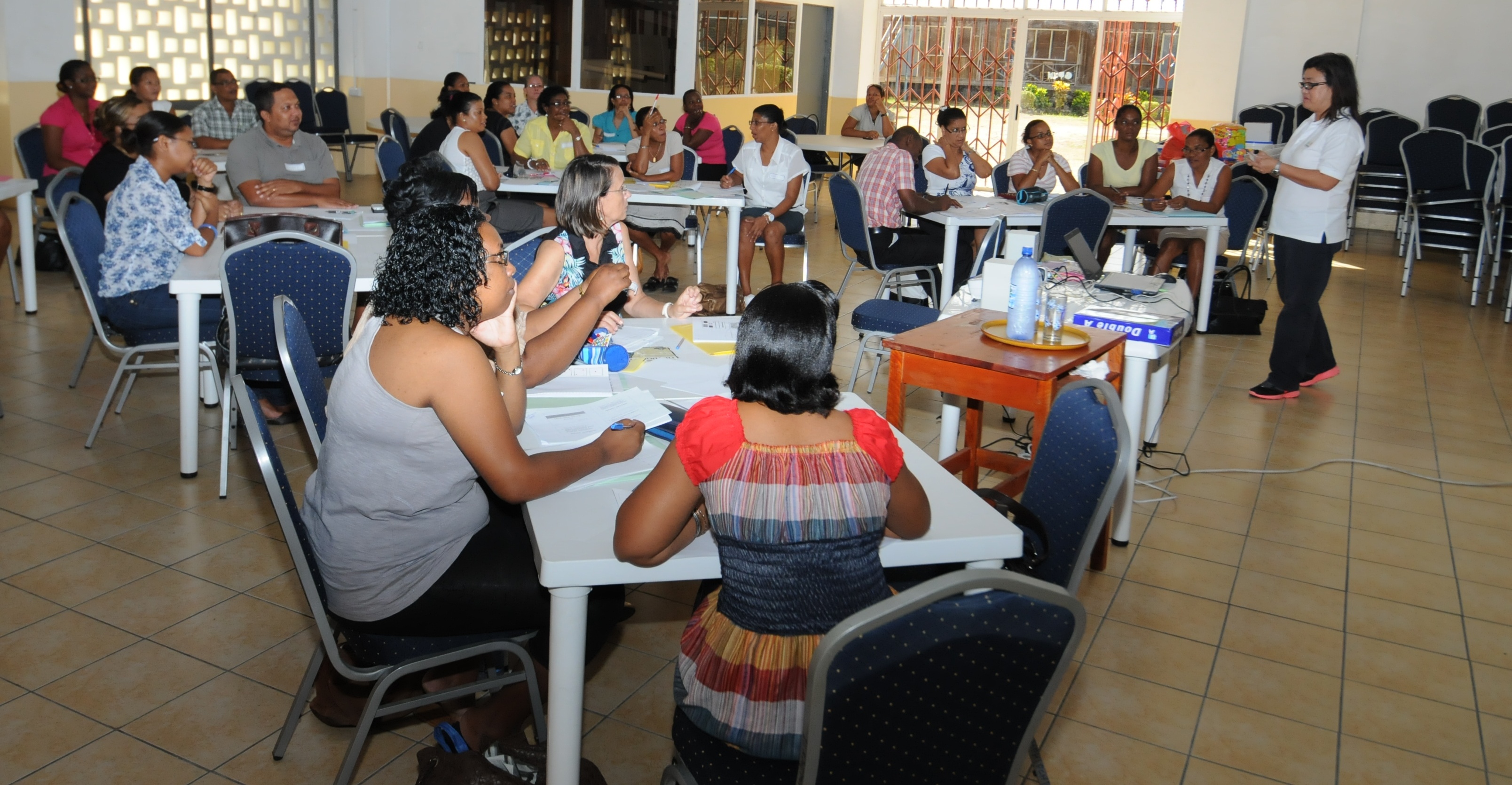
Primary school teachers are benefitting from a five-day training workshop geared at developing an early childhood mathematics training programme.
The workshop, taking place at the Ministry of Education hall, is being conducted by a senior lecturer from SEED Institute Singapore, Mona Tan. 
The proposed training programme comprises two parts – math workshop, and needs analysis and workshop for child minders.
The objective of the training is to give teachers the opportunity to explore profoundly on the ways children learn mathematics and the different approaches that teachers can use. Furthermore it is also looking at ways of developing learning programmes that is sequential, hence adapting to real life or concrete experience before abstract is used.
The training is also targeting to create an environment that promotes the learning of mathematics and examines the various strategies appropriate to evaluate learning in small children.
The benefit behind such training is that it opens up opportunities for teachers to enhance their professional development as the ones guiding and facilitating learning of the children.  This will enable for better results in children at school.
“The main purpose of this training is to shift paradigm strategies so that teachers will not just be teaching mathematics but also having fun teaching it.  This training will explore new strategies that they can use to teach mathematics, making use of natural resources found in nature, hence applicable to Seychelles therefore making it easier for kids to relate to.  So by encouraging teachers to make use of what they have and not using just paper and pencil will enable them and their pupils to explore, talk and listen from a new approach,” said Ms Tan.
The topics that the teachers are being exposed to are targeting different teaching strategies of how daily life activities can be used or included into mathematics lessons such as how to identify mathematics concepts in for example matching activities, therefore how to apply it to learning to integrate matching concepts in teaching mathematics to young children.
Ministry of Education’s curriculum development officer Ina Felix pointed out that the workshop “is a training of trainers engaged in professional development. The teachers will then be used as facilitators by the ministry to create professional development for others”.
She added that the training is one among a series of activities being done to promote the learning of mathematics, hence targeting all involved to make the learning of mathematics fun so that children can enjoy learning it.
In the second part of the series of activities already programmed, Ms Felix noted that they will be spending one week promoting mathematics by having a mathematics diagnostic centre, mathematics clinic and also a centre for mathematics enhancement programme whereby parents and children will be given a tool to use to consolidate the various mathematics concepts learned.  This will be followed by an exhibition at the National Library.
 
The teachers during one of the sessions

Special Report on Agriculture: Realizing Africa's Potential

Special Report on Agriculture: Realizing Africa's Potential

With unprecedented interest in African agriculture, business and governments are moving towards harnessing the continent’s vast potential. What will be the game-changing innovations for African agriculture?  How can financing for the sector be unlocked? With comment and insight from leading decision-makers in business, policy and development, and in partnership with the Rockefeller Foundation, the Financial Times' This Is Africa explores how Africa can realize its agricultural potential. To spotlight this series among high-level thought leaders and development practitioners around the world, the Skoll World Forum is proud to serve as a media partner for this initiative.

New judge sworn into office

New judge sworn into office


06-September-2013
Crawford Elliott Mckee from Scotland was sworn in as a Puisne Judge of the Supreme Court yesterday following his appointment by President James Michel.
The ceremony which took place at State House was attended by Vice-President Danny Faure, Speaker of the National Assembly Dr Patrick Herminie, Attorney General Ronny Govinden, Chief Justice of the Supreme Court Fredrick Egonda-Ntende, the chairman of the Constitutional Appointments Authority Jeremie Bonnelame, judges and justices of appeal as well as senior officials in the Office of the President.
The appointment of Justice Mckee follows the recommendation of the Constitutional Appointments Authority and forms part of a three-year programme of support by the Commonwealth Secretariat to the Seychelles judiciary.
President Michel expressed his congratulations to Justice Mckee after he had taken his oaths and noted that with his expertise Justice Mckee will make an important contribution towards the capacity building of the Seychelles judiciary and helping to improve its operational effectiveness.
In his remarks to the press, Justice Mckee said that one of his immediate tasks would be to help clear the backlog of court cases, and to contribute to the development of the judiciary.
He said he is looking forward to the challenges ahead.
“I feel I have a lot to contribute here and assist the country in its development.”
Justice Mckee is the eighth serving judge of the Supreme Court of Seychelles. He is a British citizen and has broad legal experience in criminal and civil matters.
He graduated from St Andrews University of Scotland in 1965 with a Bachelor of Laws (L.L.B.) and became a solicitor in Scotland in 1967. He joined a private practice in Glasgow until 1974 when he started his career in government service overseas.
His first posting was in Seychelles in 1974 as a Magistrate. Later he also served as Chief Magistrate in Seychelles until 1978. Justice Mckee has had a distinguished career in the judiciary in Scotland as well as overseas, where he has served in various posts such as Senior Crown Counsel, Acting Attorney General, Deputy District Court Judge, Stipendiary and Circuit Magistrate Judge.
Justice Mckee is a member of the Commonwealth Magistrates and Judges Association in London. He is a Public Notary in Scotland and a Member of the Law Society of Scotland.
He will take his new position shortly.
Mr Mckee takes his oath before President Michel

Sandra and Ion Kid support Autism Advocacy Project

Sandra and Ion Kid support Autism Advocacy Project


06-September-2013
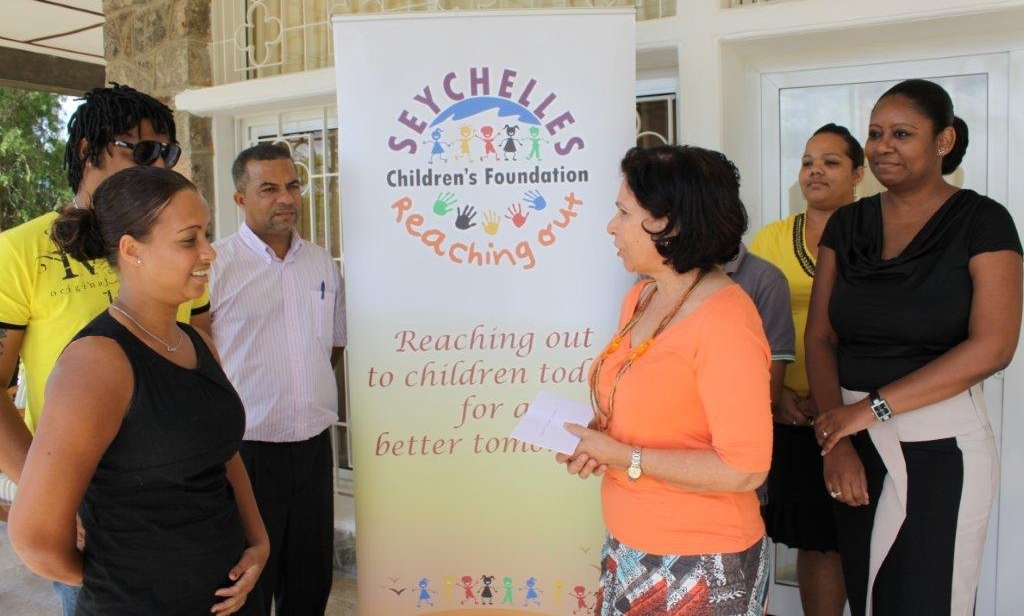
Sandra and Ion Kid, two big stars in the Seychelles’ local music industry, yesterday donated a sum of R3,000 towards a cause of their choice, that of autism – one of the projects under the auspices of the Seychelles Children’s Foundation.
The contribution, made possible from the proceeds of their recent show held on August 14 at the International Conference Centre, was accepted by Noella Gontier, chief executive officer of the Seychelles Children’s Foundation, on behalf of the First Lady and chairperson of the Foundation, in a short ceremony at the Foundation’s office at Bel Eau.
Mrs Gontier thanked the two artists for their contribution and said that the money will be put to good use towards the autism cause benefitting children with autism.
Sandra and Ion Kid were also accompanied by Sandra’s manager and father, Patel Esparon.
 
The hand over of the donation

Exploring potential of tuna by-catch

Exploring potential of tuna by-catch


06-September-2013
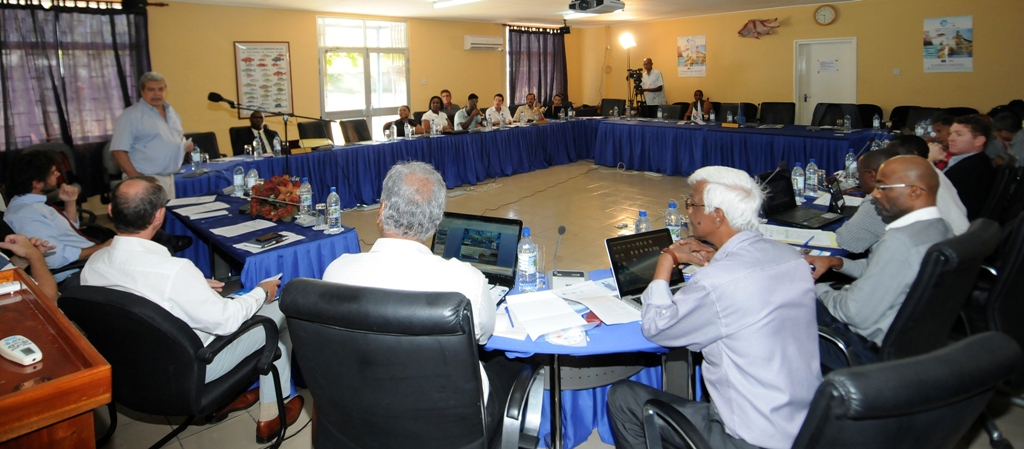
Over two dozen fisheries administrators and private sector representatives from seven countries of the region including Seychelles are meeting here to plan and carry out interventions to maximise opportunities that a tuna by-catch industry could bring to their respective countries.
The term "by-catch" is used for fish caught unintentionally while intending to catch other fish which in this specific case is tuna.
A study on by-catch from the tuna fishery industry in the Indian Ocean has already been carried out and the workshop was also to present a report on the study to the delegates.
The study was carried out under the ACP Fish II Programme which is a €30 million programme  funded by the 9thEuropean Development Fund (EDF) which aims to strengthen the capacity  of fisheries management in African Caribbean and Pacific (ACP) countries .
The programme has already provided support for the realisation of various projects and studies in the region.
The two-day workshop has been organised by the ACP Fish II Programme in collaboration with the Smartfish programme – a regional fisheries strategy for the Eastern-Southern Africa and Indian Ocean Region (ESA-IO) and is being hosted by the Seychelles Fishing Authority (SFA).
The workshop is focussing on the potential of by-catch in the region and the benefits which can be derived through value-addition either for the local market or for export.
With the implementation of the Indian Ocean Tuna Commission (IOTC) recommendation on by-catch and the EU policy of zero discards (to be gradually implemented starting from 2015), an influx of by-catch may be expected at fishing ports in the region. How can this be maximised to    ensure food security?
This workshop will serve as an eye opener and help stakeholders and governments take stock of possibilities and help them make the right decisions for the benefit of the sector and their countries.
Fisheries advisor Alejandro Anganuzzi addressed the opening session of the workshop yesterday which is also being attended by Denis Reiss from the EU delegation to Mauritius, Seychelles and Comoros, Leone Tarabusi, Regional Manager ACP Fish II for Southern Africa and Chris Short from the IOC Smartfish Programme.
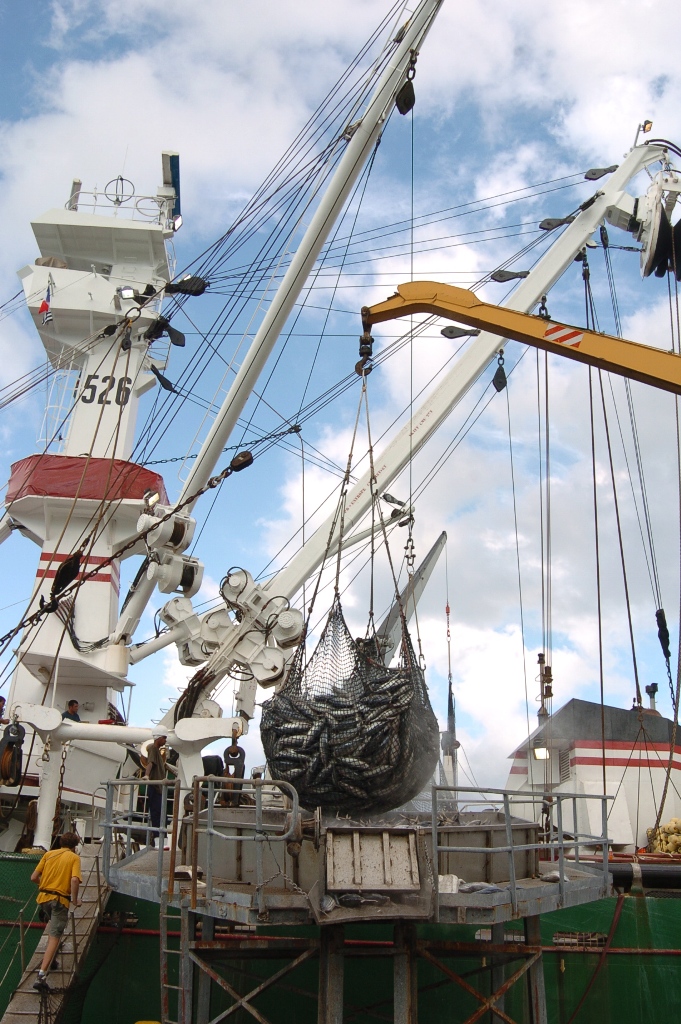
 Tuna transhipment in Port Victoria. Delegates from the region are assessing the opportunities that a tuna by-catch industry could bring to their respective countries(top right)
Mr Anganuzzi addressing delegates at the opening of the workshop yesterday

Thursday, September 5, 2013

Brazil and China scramble for agricultural influence in Africa

Brazil and China scramble for agricultural influence in Africa

Agriculture is central to Chinese and Brazilian development efforts – how trailblazing are their methods?
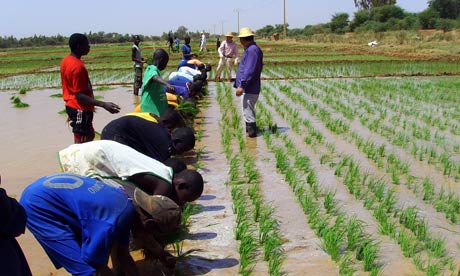
MDG : China in Africa : Rice seeding transplant training by Chinese experts in Senegal
Agricultural experts from China offer tips on rice planting to farmers in Dakar, Senegal. Photograph: Zheng Zheng/Xinhua
China and Brazil have identified agriculture as central to their development efforts in Africa, confident in the belief that they can make valuable contributions based on their own agricultural success.
China trumpets its ability to feed 20% of the world's population on roughly 10% of the world's arable land, while Brazil can boast of agribusiness-led commercial production of soya bean and ethanol as well as its promotion of smaller-scale farming.
Last month, José Graziano da Silva, the director general of the UN's Food and Agriculture Organisation, stressed the importance of south-south co-operation in advancing agricultural development in developing countries.
"It is time for Latin America to increase its contribution to African development," Graziano told African and Argentinian agriculture ministers in Buenos Aires, Argentina.
What has been the experience of Brazil and China in agriculture in Africa; do they offer a new paradigm of south-south development co-operation? A collection of essays published last month by the Institute of Development Studies concludes that there is no single Chinese, Brazilian or African position.
"China and Brazil have very different interests and priorities, and within these countries there are intense contests between different approaches, reflecting domestic political dynamics," says the IDS bulletinChina and Brazil in African Agriculture. "On the other hand, Africa's 55 countries are hugely diverse, and any new development encounter arrives on the back of a very complex agrarian history and political economy."
The case of Brazil is particularly interesting, since it offers two distinct models. The first consists of large-scale farming for the production of soya and ethanol, backed by the ministry of agriculture, livestock and food supply, which describes itself as the ministry for agribusiness. The second emphasises integrated rural and social development in Brazil's poorest regions through programmes designed to ensure the provision of technical support and credit for family farmers.
Both approaches are evident in Africa. The ministry of agrarian development (MDA), a supporter of the family farm sector, has drawn on Brazil's More Food programme, focusing on improving farmers' access to equipment, machinery and agricultural technologies, including tractors, through the provision of concessional credit. Ghana, Zimbabwe and Mozambique have been given credit and signed a technical co-operation agreement. Shipping of machines and equipment will begin this year. The challenge, says the study, is to avoid subsidised technologies that end up benefiting wealthier farmers.
At the other end of the spectrum is the involvement of agribusiness. In Ghana, for example, the Brazilian company Constran is building an ethanol plant, designated for export to Sweden, partly to get round European tariffs on Brazilian ethanol imports. So the $306m (£196m) project involves Brazilian technology and European investment in an African country.
Competing visions such as these mirror Brazil's complex agrarian economy, says the study, and the outcomes will depend on how African governments, farmers, entrepreneurs and civil society organisations absorb, shape and apply the models on offer.
While Brazil is a new player in Africa, China has been involved in African agriculture for more than 40 years. Lila Buckley, senior researcher on China at the International Institute for Environment and Development in London, writes that Chinese agriculture co-operation tends to be heavily technocratic, reflecting China's own experience. It has established more than 40 agricultural demonstration centres on the continent and provides agricultural assistance combined with infrastructure development. The latter includes dam construction with technical training, the provision of inputs and storage facilities, and facilitating links between agricultural ministries and communities.
While the Chinese official line is that China's agricultural experience can be of benefit to Africa, Chinese NGOs have offered more critical perspectives. A project officer at a Chinese NGO told Buckley: "Aid is supposed to help local people develop by introducing China's experience. But people forget to ask whether this is appropriate or not. Chinese people don't understand African history or the development situation."
There is also concern about the suitability of China's intensive agriculture model, which has achieved increased food production but only at the cost of the heavy depletion of water and soil, intense fertiliser use – which causes high pollution – and heavy energy consumption. The emphasis on technology transfer above other factors also worries some experts.
"The Gates foundation is spending $1bn on agriculture technology," an agriculture policy adviser at the Chinese Academy of Science told Buckley. "But not all technology is necessarily useful for Africa. In China, rural development started with land tenure reform, not with technology."
Buckley notes that, despite rhetoric of mutual benefit, China has generally taken the lead in designing and implementing agriculture projects, with only passive participation from African partners. This has led to frustration on both sides and project failures, as in the case of theXai-Xai irrigation scheme in Gaza province in Mozambique. When the scheme failed, one Chinese participant complained: "We are here to help farmers, but the farmers are not interested in agriculture."
Kojo Sebastian Amanor concludes that south-south co-operation – though frequently framed as path-breaking – builds upon pre-existing forms of international development, neoliberal frameworks, and the expansion of capital in Africa.


Brazil and China scramble for agricultural influence in Africa

Brazil and China scramble for agricultural influence in Africa

Agriculture is central to Chinese and Brazilian development efforts – how trailblazing are their methods?
MDG : China in Africa : Rice seeding transplant training by Chinese experts in Senegal
Agricultural experts from China offer tips on rice planting to farmers in Dakar, Senegal. Photograph: Zheng Zheng/Xinhua
China and Brazil have identified agriculture as central to their development efforts in Africa, confident in the belief that they can make valuable contributions based on their own agricultural success.
China trumpets its ability to feed 20% of the world's population on roughly 10% of the world's arable land, while Brazil can boast of agribusiness-led commercial production of soya bean and ethanol as well as its promotion of smaller-scale farming.
Last month, José Graziano da Silva, the director general of the UN's Food and Agriculture Organisation, stressed the importance of south-south co-operation in advancing agricultural development in developing countries.
"It is time for Latin America to increase its contribution to African development," Graziano told African and Argentinian agriculture ministers in Buenos Aires, Argentina.
What has been the experience of Brazil and China in agriculture in Africa; do they offer a new paradigm of south-south development co-operation? A collection of essays published last month by the Institute of Development Studies concludes that there is no single Chinese, Brazilian or African position.
"China and Brazil have very different interests and priorities, and within these countries there are intense contests between different approaches, reflecting domestic political dynamics," says the IDS bulletinChina and Brazil in African Agriculture. "On the other hand, Africa's 55 countries are hugely diverse, and any new development encounter arrives on the back of a very complex agrarian history and political economy."
The case of Brazil is particularly interesting, since it offers two distinct models. The first consists of large-scale farming for the production of soya and ethanol, backed by the ministry of agriculture, livestock and food supply, which describes itself as the ministry for agribusiness. The second emphasises integrated rural and social development in Brazil's poorest regions through programmes designed to ensure the provision of technical support and credit for family farmers.
Both approaches are evident in Africa. The ministry of agrarian development (MDA), a supporter of the family farm sector, has drawn on Brazil's More Food programme, focusing on improving farmers' access to equipment, machinery and agricultural technologies, including tractors, through the provision of concessional credit. Ghana, Zimbabwe and Mozambique have been given credit and signed a technical co-operation agreement. Shipping of machines and equipment will begin this year. The challenge, says the study, is to avoid subsidised technologies that end up benefiting wealthier farmers.
At the other end of the spectrum is the involvement of agribusiness. In Ghana, for example, the Brazilian company Constran is building an ethanol plant, designated for export to Sweden, partly to get round European tariffs on Brazilian ethanol imports. So the $306m (£196m) project involves Brazilian technology and European investment in an African country.
Competing visions such as these mirror Brazil's complex agrarian economy, says the study, and the outcomes will depend on how African governments, farmers, entrepreneurs and civil society organisations absorb, shape and apply the models on offer.
While Brazil is a new player in Africa, China has been involved in African agriculture for more than 40 years. Lila Buckley, senior researcher on China at the International Institute for Environment and Development in London, writes that Chinese agriculture co-operation tends to be heavily technocratic, reflecting China's own experience. It has established more than 40 agricultural demonstration centres on the continent and provides agricultural assistance combined with infrastructure development. The latter includes dam construction with technical training, the provision of inputs and storage facilities, and facilitating links between agricultural ministries and communities.
While the Chinese official line is that China's agricultural experience can be of benefit to Africa, Chinese NGOs have offered more critical perspectives. A project officer at a Chinese NGO told Buckley: "Aid is supposed to help local people develop by introducing China's experience. But people forget to ask whether this is appropriate or not. Chinese people don't understand African history or the development situation."
There is also concern about the suitability of China's intensive agriculture model, which has achieved increased food production but only at the cost of the heavy depletion of water and soil, intense fertiliser use – which causes high pollution – and heavy energy consumption. The emphasis on technology transfer above other factors also worries some experts.
"The Gates foundation is spending $1bn on agriculture technology," an agriculture policy adviser at the Chinese Academy of Science told Buckley. "But not all technology is necessarily useful for Africa. In China, rural development started with land tenure reform, not with technology."
Buckley notes that, despite rhetoric of mutual benefit, China has generally taken the lead in designing and implementing agriculture projects, with only passive participation from African partners. This has led to frustration on both sides and project failures, as in the case of theXai-Xai irrigation scheme in Gaza province in Mozambique. When the scheme failed, one Chinese participant complained: "We are here to help farmers, but the farmers are not interested in agriculture."
Kojo Sebastian Amanor concludes that south-south co-operation – though frequently framed as path-breaking – builds upon pre-existing forms of international development, neoliberal frameworks, and the expansion of capital in Africa.