Thursday, March 28, 2013

Malbrook voted athletes’ commission head - 27.03.2013

Malbrook voted athletes’ commission head - 27.03.2013

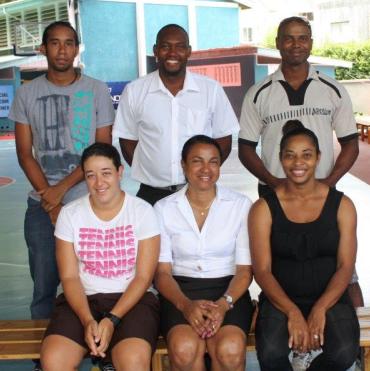
Simone Malbrook has been re-elected chairperson of the athletes’ commission of the Seychelles Olympic and Commonwealth Games Association (Socga).
Standing from left to right: Nelson Renaud, Georgie Cupidon and Tony Lespoir, sitting from left to right: Clyvie Delpech, Simone Malbrook and Janet Georges

First elected into office in February last year to run the committee for one year, the veteran female basketballer was given another vote of confidence during the commission’s annual general meeting.
Weightlifter Janet Georges has replaced sprinter Danny D’Souza as vice-chairperson. Petanque player Bernard Denis is the secretary, while the four ordinary members are athlete Nelson Renaud, tennis player Clyvie Delpech, badminton player Georgie Cupidon and canoeist Tony Lespoir.
The new committee has a four-year mandate that runs concurrently with that of Socga executive committee.
As athletes’ commission chairperson, Mrs Malbrook becomes an ordinary member of the Socga executive committee and takes part in Socga’s committee meetings where she represents the views, rights and interests of athletes.
The other Socga ordinary members are Selby Dora, Michel Bau, Donald Célestine and Tracey Hétimier.
Antonio Gopal is the Socga president, Hughes Adam vice-president, Alain Alcindor secretary general and Mary Banane treasurer.
G. G.

| Future Paralympians take part in ‘Get inspired festival’


Print this page
 | Email this page
Future Paralympians take part in ‘Get inspired festival’ - 27.03.2013

Seychellois who aspire to take part in the Paralympic Games got a feel of three of the activities they can take up. That was during last Saturday’s ‘Get inspired festival’ at the Palais des Sports.
Minister Meriton speaking to those who took part in Saturday’s session

Representatives of the deaf, and blind associations, School for the Exceptional Child and the rehabilitation centre, parents, coaches and other volunteers took part in the fun-filled day run by Rwanda National Paralympics Committee boss Dominique Bizimana.
Mr Bizimana, who represented Rwanda at last year’s Paralympics Games in London, United Kingdom but has since retired from playing sitting volleyball, has said he is committed to popularising the sport and helping Seychelles engage itself in joining the International Paralympics Committee.
A Tutsi, Mr Bizimana lost the lower half of his left leg fighting for the Rwandan Patriotic Front.
Mr Bizimana is on a mission here together with Elias Musangeya, senior development consultant at UK Sport.
Social Affairs, Community Development and Sports Minister Vincent Meriton, National Sports Council chief executive Alain Volcère were on hand to see for themselves how the locals get along learning to play sitting volleyball, boccia and goalball.
Mr Musangeya told Sports Nation last week that they want to support the development of Paralympics in Seychelles and had noticed that Seychelles has the capacity but needed strategic support.
To be able to compete at the Paralympics, Seychelles first has to set up a local Paralympics association which will be affiliated to the International Paralympics Committee by September this year.
Messrs Musangeya’s and Bizimana’s visit here was made possible by the Seychelles government and the British high commission.
Mr Bizimana (fifth from right) giving instructions during the boccia rehearsal
Their visit has come less than a year after Minister Meriton represented President James Michel, who had been invited by the UK government, at the opening ceremony of the Paralympics Games (from August 29 to September 9, 2012).
In his meeting with Henry Bellingham MP, Parliamentary Under-Secretary of State in the Foreign and Commonwealth Office, who has the ministerial portfolio for Africa, Minister Meriton discussed the possibility of working in partnership with the UK to develop sports and the social renaissance initiative here.
The Paralympic Games is a major international multi-sport event, involving athletes with a range of physical and intellectual disabilities, including mobility disabilities, amputations, blindness, and cerebral palsy.
There are winter and summer Paralympic Games, which since the 1988 Summer Games in Seoul, South Korea, are held immediately following the respective Olympic Games. All Paralympic Games are governed by the International Paralympic Committee.
Classification is a unique element of Paralympic sports, intended to ensure fair competition. As each sport at the Paralympic Games requires different skills and competencies, the impact of impairment on the performance of the athletes varies. This is why it is important for each sport to have its own unique classification rules.
G. G.

CF congratulates judo gold medallist Jean Michel Vidot - 27.03.2013

CF congratulates judo gold medallist Jean Michel Vidot - 27.03.2013

Gold medallist in the cadet -55kg class at the international judo tournament in Mauritius, Jean-Michel Vidot, 15 and a resident of the President’s Village, has made the foundation and Seychelles proud.
Jean-Michel Vidot sporting his gold medal
On behalf of First Lady and chairperson of the Seychelles Children’s Foundation (SCF), Natalie Michel, SCF chief executive Noella Gontier presented Jean-Michel with a gift last week.
Mrs Gontier congratulated Jean-Michel for his excellent achievement and wished him continued success for the future – both in his sport and academic studies.
On his part, Jean-Michel thanked the foundation for its continued support. He said that without the support of the foundation, he would not have been able to take part in the tournament and come out a winner.
“I’m very happy to have won the -55kg category of the tournament,” said Jean-Michel, who described the fight as “very easy!”
Jean-Michel is the child ambassador for the SCF. In 2011, he won a silver medal in the Jeux de l’Espoir in Mauritius.

| Aviation bodies extend satellite services accord


Print this page
 | Email this page
Aviation bodies extend satellite services accord - 27.03.2013

Representatives from North and Eastern African countries have taken part in the ninth Northern African and Indian Ocean telecommunications via satellite (Nafisat) seminar, which was co-hosted in Seychelles for the first time by the Seychelles Civil Aviation Authority (SCAA).
Delegates on the final day of the workshop yesterday
Nafisat is a regional VSAT (telecommunication via satellite) network used for the purpose of dissemination of air traffic and flight information between air traffic control centres in the northern and eastern African states. The network is administered by Air Traffic Navigation Services (ATNS) of South Africa but owned by the member states.
The committee, which represents 14 countries, including Egypt, Ethiopia, Eritrea, Djibouti, Kenya, Libya, Saudi Arabia, Seychelles, Somalia, South Africa, Sudan, Tanzania, Uganda, and Yemen, has a supervisory role to ensure that the administration and management of the communication via satellite network is running smoothly. They meet annually to discuss performance issues, analyse finances and decide on cost-recovery fees to be charged to airlines.
Rushj Lehutso, executive commercial services at ATNS, said that the pressing issue on the table this year was that the current agreements in place would be expiring in 2015, and that a decision needed to be taken as to whether ATNS’ service contract would be renewed.
“The committee reached the decision that ATNS’ contract would be extended for the following seven years, which will take us to 2022,” said Mr Lehutso.
“I commend the member states for their forward-planning. Some of our biggest challenges in the continent revolve around foresight, vision and the ability to avoid unnecessary crises.”
Mr Lehutso added that the decision enabled ATNS to release the investment needed to upgrade the current system and plan ahead for future requirements and new technology.
“It is essential that this critical, via-satellite, telecommunication network continues to operate smoothly to ensure safety and efficiency of flights over Africa. We also need to guarantee continuity of this service by planning for the future well in advance,” says Ms Lise Morel, the SCAA general manager of telecommunication and information systems.
 “This network is a superb example of how African states can indeed get together for the benefit of all,” Ms Morel said.

Special welcome for arrivals from Hong Kong - 27.03.2013

Special welcome for arrivals from Hong Kong - 27.03.2013 

The first Air Seychelles flight from Hong Kong touched down at the Seychelles International Airport with 71 passengers, many of them tourists – at 6.30am yesterday.
The first Air Seychelles passengers from a Hong Kong flight at the airport yesterday
The arrivals were treated to the traditional music of the Latroup Nasyonal and welcome gifts from staff of the Seychelles Tourism Board.
The Airbus 330 aircraft named Aldabra left Seychelles on Sunday with 70 Seychellois representatives from government, businesses and media amid a warm send off. Its journey back started at 6pm Hong Kong time and passengers had a one hour fifty-minute stopover in Abu Dhabi.
It was flown back under the command of Captain François Jackson.
On the flight were Chinese tourists coming to Seychelles for the first time.
They were full of praise for the hospitality of the cabin crew.
Information technology engineer Yu Rin was among the passengers.
He and his newly wedded wife Xiao Xiang Xiang told Nation they were excited to be in Seychelles for their honeymoon.
Happy to be here for their honeymoon: Mr Yu and his newly wedded wife Xiang (Photo by G.T.)
“We knew about Seychelles as a tourist destination from the internet and came to learn it is a place where you can enjoy sunshine and the hospitality of very special people,” he said, adding they found the food on the flight very delicious.
The 13-hour flight passed through Abu Dhabi and the next flight left Seychelles for Hong Kong at 3.40pm. There will be another departure tomorrow at the same time followed by a Sunday afternoon one.
The airport also saw the arrival in the afternoon of 200 Israeli tourists on a chartered flight (see separate story on page 5), the first of two such flights expected this year, but missing was the Kenya Airways Tuesday flight currently suspended “for commercial reasons until April 2”.

President James Michel

 President James Michel
 
Print this page | Email this pageSri Lankan minister discusses implementation of accords with President Michel - 27.03.2013

The Sri Lankan External Affairs Minister, Prof. Gamani Lakshman Peiris, was yesterday received by President James Michel at State House where they discussed implementation of cooperation agreements notably in fisheries, trade, education, defence and finance.
Minister Peiris in talks with President Michel
Prof Peiris, who has been Minister for External Affairs since 2010, called the existing cooperation between the two Indian Ocean island states as “multi-faceted and said it has been strengthened since President Michel’s visit to Sri Lanka last year.
He noted that Sri Lanka’s President, Mahinda Rajapaksa, is scheduling a visit in Seychelles soon, while President Michel is also due to attend the Commonwealth Summit in Colombo in November.
He said things have moved fast within a very short period, producing remarkable results, with several projects implemented, because of the commitment and reciprocity of the two countries’ leaders.
Prof. Peiris on Monday visited the Seychelles Coastguard base and was due to tour the Maritime Training Centre yesterday afternoon.
He was accompanied at State House by Sri Lanka’s honorary consul in Victoria, Roy Fonseka, and also met Vice-President Danny Faure, where they were joined by Foreign Affairs Minister Jean-Paul Adam.
On his talks with President Michel, he said they focused on the “blue economy” which, he said, does not mean just fisheries, but also concerns trade, shipping and maritime activities linked to tourism.
A few months after President Michel’s visit to Colombo, the Sri Lankan Fisheries Minister, Rajitha Seneratne, visited Seychelles, providing an opportunity for our two countries to bolster our fisheries partnership.
As discussed during President Michel’s visit, a $10 million line of credit, to be used in trade and commercial transaction with Sri Lanka, was agreed to be made available. The funds will also be used for boatbuilding in Sri Lankan shipyards to benefit Seychelles’ long lining industry.
In the field of education, he noted that already some 30 Sri Lankan teachers are in Seychelles to teach and lecture in both secondary and post-secondary institutions.  Collaboration between the University of Seychelles and Colombo University was also discussed.
On Defence, Prof. Peiris said Sri Lanka has offered  some excellent military training for Seychelles military personnel. One Seychellois member of the Seychelles People’s Defence Forces (SPDF) is already training in Sri Lanka and five others will also be going for training soon.
The Sri Lankan External Affairs Minister said the talks covered finance, an area where the two countries have a Double Taxation Avoidance Agreement since September 2011. He noted that the “Bank of Ceylon” is considering setting up a branch in Victoria.
During his visit the Sri Lankan Minister also paid a courtesy call on the Speaker of the National Assembly, Dr Patrick Herminie.

Tuesday, March 26, 2013

Concrete plan to keep drivers on right track - 26.03.2013

Concrete plan to keep drivers on right track - 26.03.2013

The Seychelles Land Transport Agency (SLTA) will install concrete bollards to ensure vehicles travelling towards town keep right after the roundabout near Eden Island, the agency’s chief executive Parinda Herath said yesterday.
Work has started in preparation for the installation of concrete bollards
Until last year vehicles were passing on the left on that part of the road leaving the right lane vacant, but as traffic jams grew many drivers started using it to unfairly overtake law abiding road users crawling on the left lane.
This forced the SLTA to put marks on the road in June 2012 advising motorists to keep right, leaving the left track as an acceleration lane which they will now no longer have access to it after the agency installs concrete bollards with reflectors at a cost of R90,000 to compel drivers to keep right.
The concrete structures will replace rubber cones placed on the road during the weekend to guide drivers.
These rubber cones, placed on the road during the weekend to guide drivers, will be replaced by concrete structures
Immediately after the section, however, the drivers will keep left as usual when they share the road further down with oncoming south-bound traffic.
Cones placed between the airport and Pointe Larue to help vehicles avoid driving into flooded and therefore invisible channels during the rainy season have been removed and will be replaced by metallic markers with reflectors, said Mr Herath.

Met gets new weather stations - 26.03.2013

Met gets new weather stations - 26.03.2013 

Six new automatic weather stations (AWS) will soon be installed around the country, boosting the ability of the Seychelles National Meteorological Services to predict weather even more correctly.
Mr Dodin checking an AWS as it transmits data to website www.wunderground.com (Photo by G.T.)              Ms Agricole with an AWS that was sending data to the European Organisation for the Exploitation of Meteorological Satellites for global distribution (Photo by G.T.)

The director of Met services Vincent Amelie said this yesterday as the SNMS continued to mark the World Meteorological Day.
“Two of the stations have been donated by the World Meteorological Organisation and will add to four other stations funded by the Danish government under an adaptation programme for African countries,” he told Nation.
“All these pieces of equipment are expected in the country in the next few weeks and will be installed on various places on Mahé and the inner islands including one on Aldabra.”
He said at present Seychelles has a number of manual stations scattered around the country and readings are taken by voluntary observers, but these stations record only rainfall. It is only at the main meteorological station at the Seychelles international airport that other weather parameters apart rainfall are also measured.
“With installation of these new AWS, we will have sensors for temperature, pressure, wind, rainfall, humidity and radiation, beefing up the observation network across the country to increase monitoring and promote climate change adaptation. Apart the AWS there are six data loggers received from the UK meteorology late last year which are now being tested at the main met office before being deployed at different locations,” he said.
“A data logger is an automatic rain gauge which transmits data every second via a wireless system. Apart from being automated this type of equipment permits the accessibility of rainfall data at any time especially during bad weather conditions and permits a faster response to warn the community of a disaster.  This is a great advantage over the current network which are being read manually only once at 7am with information being passed over to us by telephone.
Technical officer Jean Paul Dodin and Rouma Agricole of the SNMS yesterday showed Nation two of the AWS at the South East Island near the airport.
The one Mr Dodin is photographed with was transmitting data by wireless means to computers on the island where he showed us real time readings which were uploaded on website www.wunderground.com where anybody around the world can access it.
Ms Agricole showed us another AWS which sends data to The European Organisation for the Exploitation of Meteorological Satellites (Eumetsat) which distributes the data worldwide.

Air Seychelles celebrates first flight to Hong Kong - 26.03.2013

Air Seychelles celebrates first flight to Hong Kong - 26.03.2013 

The Air Seychelles’ inaugural flight to Hong Kong touched down at Hong Kong’s International Airport some 40 minutes after 8am Hong Kong time (40 minutes after 4am Seychelles time) yesterday morning after a short transit stop at the Abu Dhabi Airport.
The symbolic ribbon-cutting ceremony during the brief stop in Abu Dhabi to mark Air Seychelles’ inaugural flight to Hong Kong
On board this Airbus A330-200 aircraft’s first flight from Seychelles to Hong Kong were the Minister for Home Affairs and Transport Joel Morgan, who is also the chairperson of Air Seychelles, the Minister for Tourism and Culture Alain St Ange, the airline’s chief executive Cramer Ball, senior government officials from Seychelles and the People’s Republic of China, and a group of local journalists.
Other journalists from China, Abu Dhabi and Hong Kong joined the delegation for a press conference at the Ritz Carlton Hotel just after the flight arrived in Hong Kong yesterday morning.
During the brief stop in Abu Dhabi, Air Seychelles, Etihad and Abu Dhabi representatives joined together for a symbolic ribbon-cutting ceremony to mark the occasion.
The airline’s chief executive described this first flight as a momentous occasion as the aircraft received water canon salutes on its arrival – both in Abu Dhabi and Hong Kong.
The press conference at the Ritz Carlton Hotel just after the flight arrived in Hong Kong yesterday morning
“This is a great day for Seychelles, for Hong Kong and for Abu Dhabi. The start of flights to Hong Kong is a momentous occasion for Air Seychelles, capping a remarkable year in which we returned to profitability,” said Mr Ball.
Those attending the conference also had a chance to view a short video on Air Seychelles and its partnership with Etihad.
“With Air Seychelles you start living your holiday the moment you board the aircraft with the warm and unique welcome received,” said Mr Ball.
Mr Morgan, for his part, described the event as historic for Seychelles and Air Seychelles, adding that visitors from Hong Kong will be astounded by what Seychelles has to offer.
“Our people, our hotels are ready to receive and welcome you,’’ he said, calling on the press people present to make the Seychelles destination known to Hong Kong.
Minister Morgan further added that the new three-flight-a-week to Hong Kong via Abu Dhabi will be an added boost to diversifying the Seychelles tourism market.
For his part, the chief commercial officer of Etihad Airways Peter Baumgartner said the airline’s aim is to be the best and not the largest. He noted that Etihad Airways is a newcomer to Hong Kong but has been flying to mainland China since 2008.
Minister St Ange also gave an overview of the Seychelles tourism industry and was also part of the panel which answered questions posed by foreign journalists.
Seychelles Nation, represented at the event in Hong Kong by journalist Marie-Anne Lepathy (who filed this report) and photographer Joena Bonnelame (who took the accompanying photographs), will later this week bring its readers more stories and photos on the historic flight to Hong Kong. 

Friday, March 22, 2013

Best hospitality student meets with Seychelles President


Best hospitality student meets with Seychelles President

Best hospitality student meets with Seychelles President
Photo from Seychelles Ministry of Tourism and Culture
Mar 21, 2013
Seychelles President James Michel met with Mrs. Rose-May Lavigne, nee Payette, a Seychellois student who is the overall Best Academic Student of Shannon College of Hotel Management of Ireland for 2013, this afternoon at State House.
Also present during the meeting were the Minister for Tourism and Culture, Mr. Alain St. Ange; the Secretary General of the Office of the President, Mrs. Lise Bastienne; the Chief Executive Officer of the Seychelles Tourism Board, Mrs. Elsia Grandcourt; the Principal of the Seychelles Tourism Academy Mr. Flavien Joubert; and Mrs, Lavigne’s father, Mr. Denis Payette.
The President congratulated Mrs. Lavigne on her outstanding performance at Shannon College. Her course and training were part of a twinning program with the Seychelles Tourism Academy, a program initiated by the President in 2009. The first group of Seychellois students started studying there in 2011.
“You and the other students have done well to make our country happy and proud. You are a shining example of our students’ ability to excel. I hope you will make good use of your knowledge to build the Seychelles Brand and to be a role model for Seychellois tourism managers in the future,” commented President Michel.
Mrs. Lavigne forms part of a group of thirteen Seychellois students from the Seychelles Tourism Academy who graduated with a Bachelor’s Degree in Hospitality Management on March 7, 2013 in a cohort of about a hundred European students. It is to be noted that this is the first batch of students which have completed their degree tailored by the Shannon College of Hotel Management of Ireland.
During the meeting at State House, the President and Mrs. Lavigne discussed possibilities for her to further her studies, her experience in Ireland, the graduates’ future in the tourism industry, the President’s vision to retain Seychellois professionals in the industry, and programs being envisioned to that end.
Mrs. Lavigne thanked everyone who has supported her and her fellow graduates throughout their studies. She further expressed her gratitude to President Michel and the government of Seychelles for their commitment in initiating the training program, its funding, and their belief in the Seychelles Tourism Academy. She emphasized that it was encouraging to see that they had come back to a strong system of support. “The STA and Shannon College have thought me so much. Being at the College has built up my confidence. I am very happy, and I know I will move up slowly but surely,” said Mrs Lavigne.
Mrs. Lavigne now wishes to acquire more work experience at the Allamanda Hilton Hotel and, subsequently, further her studies at Master’s level, covering topics such as finance, business studies, and marketing which she feels are important to help grow the hotel industry.
Such an accomplishment illustrates the strategy and programs being implemented by the Seychelles Tourism Academy to pave the way for the Seychellois Hospitality Management professionals to take up key positions within the Seychelles tourism industry.

Thursday, March 21, 2013

PTA Bank confident in Seychelles

PTA Bank confident in Seychelles’ - 21.03.2013 
. Lends Eden Island US $15m

The PTA Bank has confidence in Seychelles where all the projects it has supported have been successful, its president and chief executive Admassu Tadesse said yesterday.
Vice-President Faure welcoming Mr Tadesse at State House yesterday
He was speaking after holding talks with Vice-President Danny Faure at State House where the bank head announced his organisation has loaned Eden Island US $15 million for the third phase of its housing project.
“The money is to further infrastructure development and allow new developments to come through including more affordable housing in the future,” he said.
He said the bank has also discussed with other stakeholders what other projects the bank can support, being a long-term and short-term lender.
“We have been looking at projects in the retail, transport, the sea and airport sectors as well as container terminals.”
Mr Tadesse said the bank is also looking at the food and beverage sector and is now considering agriculture after he met top officials from that sector to see how it can be revived being “an important strategic area”.
He said the PTA Bank is happy with the projects it has so far identified and supported because they have succeeded, “making both Seychelles and the bank look good”.
Mr Faure and Mr Tadesse discussed the strength of the relationship between Seychelles and the bank, noting that the Vice-President has been involved in its transformation as it changed its constitution.
“We also discussed the repositioning of Seychelles as a gateway into Africa and the growth of the services sector – how the bank can help Seychelles leverage itself to better avail itself as one of many gateways or platforms from which to do business in Africa in a pleasant and secure manner,” he said, adding they looked at ways in which Seychelles is looking to integrate further in Africa for example in maritime and transport point of view.
“We believe in Seychelles for many reasons, first of all its performance. Projects have done very well here. There has been very strong commitment from the leadership of the country at various levels and the country has managed to turn itself around economically, which has inspired confidence.
“We think Seychelles is disciplined and we intend to strengthen our partnership with it as it clearly has a bright future.

PTA Bank confident in Seychelles

PTA Bank confident in Seychelles’ - 21.03.2013 
. Lends Eden Island US $15m

The PTA Bank has confidence in Seychelles where all the projects it has supported have been successful, its president and chief executive Admassu Tadesse said yesterday.
Vice-President Faure welcoming Mr Tadesse at State House yesterday
He was speaking after holding talks with Vice-President Danny Faure at State House where the bank head announced his organisation has loaned Eden Island US $15 million for the third phase of its housing project.
“The money is to further infrastructure development and allow new developments to come through including more affordable housing in the future,” he said.
He said the bank has also discussed with other stakeholders what other projects the bank can support, being a long-term and short-term lender.
“We have been looking at projects in the retail, transport, the sea and airport sectors as well as container terminals.”
Mr Tadesse said the bank is also looking at the food and beverage sector and is now considering agriculture after he met top officials from that sector to see how it can be revived being “an important strategic area”.
He said the PTA Bank is happy with the projects it has so far identified and supported because they have succeeded, “making both Seychelles and the bank look good”.
Mr Faure and Mr Tadesse discussed the strength of the relationship between Seychelles and the bank, noting that the Vice-President has been involved in its transformation as it changed its constitution.
“We also discussed the repositioning of Seychelles as a gateway into Africa and the growth of the services sector – how the bank can help Seychelles leverage itself to better avail itself as one of many gateways or platforms from which to do business in Africa in a pleasant and secure manner,” he said, adding they looked at ways in which Seychelles is looking to integrate further in Africa for example in maritime and transport point of view.
“We believe in Seychelles for many reasons, first of all its performance. Projects have done very well here. There has been very strong commitment from the leadership of the country at various levels and the country has managed to turn itself around economically, which has inspired confidence.
“We think Seychelles is disciplined and we intend to strengthen our partnership with it as it clearly has a bright future.

Major move to ease sailing for our ships

Major move to ease sailing for our ships - 21.03.2013

Steps have started to put Seychelles on International Maritime Organisation’s (IMO) White List which will make it much easier for ships flying our flag – including the tankers – to sail around the world.
Mr Alcindor launching the efforts yesterday
Following President James Michel’s visit to Sri Lanka, two experts from that country are here to help us kick start the efforts in which proper training is a key requirement.
Captain Dular Amarasuriya told Nation that ships flying flags of countries that are not on the list are  targeted for stricter and lengthier inspection by state port control authorities who may choose not to accept seafarers with certificates issued by non White List countries for service on its ships.
He is a master mariner from Sri Lanka’s Colombo International Nautical & Engineering College (Cinec) which Mr Michel visited in August last year and said:
“I was greatly impressed by the training offered by Cinec, and we have discussed the possibility to develop a partnership with the Seychelles Maritime Training Centre (MTC).”
The college trains 14,000 students a year and offers programmes of maritime science study from certificate level to Bachelors, Masters and Doctoral Degrees with internationally recognised certification.
One of the conditions for a country to be accepted on the White List is to have properly trained and qualified seafarers, hence among the people attending the launch of the efforts yesterday at the Seychelles Petroleum Company were principal secretary for education Merida Delcy and MTC’s top instructors including its head Brian Hoareau.
Also present were the director general of the Seychelles Maritime Safety Administration Joachim Valmont and senior Seychelles Coast Guard officials.
Giving our local team presentations on what we need to do to be on the White List with Capt Amarasuriya was Sri Lankan consultant in maritime training, chief engineer Leslie Hemachandra.
As a follow up to Mr Michel’s visit, the head of Cinec and his deputy came to Seychelles to see how the college can help improve our maritime training.
Launching the presentations, the acting director for technical and further training Jean Alcindor said among what Mr Michel wanted was for Cinec to help the MTC with curriculum improvement specifically targeting access into the White List.
He said after meeting with Education Minister Macsuzy Mondon and Mrs Delcy, they wrote a report on their fact finding mission with recommendations on how we can achieve that goal.
“They also urged the further training of trainers and revision of the maritime training
Capt Amarasuriya – who met Mr Michel’s delegation in Sri Lanka – said his team is happy to support our efforts “from the bottom of our hearts”.
President Michel visiting the Colombo International Nautical & Engineering College (Cinec) in August last year
He said the presentations were centred on showing us what are the requirements for a country to get on the vital list and how to attain them, how Sri Lanka got on it and the way they overcame the challenges they faced and also to prepare the fishing industry to meet upcoming regulations.

Monday, March 18, 2013

Seychelles Stresses Importance of Blue Economy in TICAD Process

Seychelles Stresses Importance of Blue Economy in TICAD Process

17.03.2013
Speaking at the TICAD Ministerial meeting in Addis Ababa, Foreign Minister Jean-Paul Adam has highlighted that Japan's strong historic relationship with oceanic development, means that the development of the blue economy is a great opportunity to the TICAD V process.
In his intervention, Minister Adam emphasised the importance of African ownership in the process of developing the blue economy, as it is important to empower a new generation of African entrepreneurs. He also stressed the importance of public private partnerships.
Seychelles also called for a strong focus on human capacity development as a key component in facilitating this sense of ownership, and also in creating new opportunities for young people.
The Minister also highlighted the importance of measures to mitigate and facilitate adaptation to climate change in the context of TICAD as the challenge of climate change was disproportionately more destructive in Africa.  In the context of the theme of 'Inclusiveness and Resilience', Seychelles and many other African island states, such as Cape Verde and Mauritius, highlighted the importance of having appropriate mechanisms that take into account the particular vulnerabilities of African islands.
The Seychelles delegation also asked the there be a specific focus on renewable energy in the TICAD process as it was important to improve Africa's energy security to improve overall resilience.
The Tokyo International Conference on African Development (TICAD) is an international development mechanism co- chaired between the Government of Japan and African nations.  It was first launched in 1993 and has facilitated the flow of development assistance to many African countries including Seychelles.
The ministerial meeting being held in Addis Ababa is preparing for the Summit of Heads of State and Government, which will be held in Yokohama later this year.
The Minister is accompanied at the conference by Ambassador Maurice Loustau-Lalanne, Principal Secretary in the Ministry of Foreign Affairs.

Thursday, March 14, 2013

Sports federations and associations address common issues


Print this page
 | Email this page
NSC’s forum - 14.03.2013
Sports federations and associations address common issues

Sports federations and associations have common issues and they addressed those with parent organisation National Sports Council (NSC) in Saturday’s forum.
The meeting in progress     (photo G. G.)

The first of four forums took place at the Maison Football auditorium and was attended by representatives of most sports, except football, karting, swimming, badminton, canoeing to name just a few.
NSC chief executive Alain Volcère told Sports Nation the forum, the first of its kind, has been very fruitful as representatives of sports federations and associations have been able to voice out their concerns.
“It has been a very good experience with some very good debates on issues that touch all local sports federations and associations,” said Mr Volcère.
“It was an opportunity for the NSC to take stock of the concerns the sports federations and associations have in trying to deliver a better job in developing sports in Seychelles.
“From this first meeting, we have noted that although the government injects quite a large sum into sports development, financing remains a big concern and the NSC will in the near future invite potential sponsors to meet representatives of federations and associations. This way, the two parties can exchange ideas about how best they can work in partnership.
“Sports federations and associations have to come well prepared to convince the sponsors and show them what they can get in return for sponsoring their sports,” noted Mr Volcère.
He added that the second forum is slated for June, the third in September and fourth in December.
Cindy Souffe of the customs division within the Seychelles Revenue Commission (SRC) talked about the customs procedures in place to clear sporting equipment from the port and airport.
She added that the customs division already has a list provided by the National Sports Council (NSC) of all the equipment, spare parts and other items that fall under the exempted goods.
Those present called on the NSC to add cars, buses and bicycles to the list. This is because an athlete might win a car as a prize in an international competition and as it is right now, he/she must pay all the taxes at the port.
Ms Souffe’s colleague Mona Mussard explained the mechanisms of the rebate formula under the new corporate social responsibility scheme and explained that all donations should go through the Liaison Unit of Non-governmental Organisations (Lungos) which vet all the documents before sending a written document to the Ministry of Finance, Trade and Investment.
NSC’s director for sports management and development Robert Auguste insisted on sports federations and associations sending reports to his unit after attending international competitions.
He also noted that a federation has to make a request to host an international competition at least six months prior to the date, giving the NSC enough time to work on the logistics.
Loss of earnings for locally based players who are employed and self-employed, for Seychellois professionals, financial help like monthly allowance for coaches, travel insurance were some of the issues Mr Auguste explained.
Mr Auguste said all members of national selection are insured by the NSC and this is subject to medical tests carried out at least once a year.
He noted that all injuries sustained by athletes should be reported to the NSC within 72 hours.
Giovanna Rousseau, the head of the marketing and promotion unit gave those present some tips about how to go about looking for sponsorship. She noted that the main difference between donation and sponsorship is the donors don’t expect anything in return when they make a donation, but sponsors expect something in return from the contributions.
Fund-raising activities, membership fees, gate receipts, lotteries, sponsored walks are just some of the ways the sports bodies can raise funds.
Medgée Bijoux of the human resources and budget management section gave a detailed explanation of how requests for transport should be done.
Bernard Denis, the sports training and capacity building director, talked at length about the three training programmes – National Coaches Accreditation Programme, Advanced Sports Management Course, and Sports Medical Assistant Course – run by his section.
Those present wanted to know if the certificates given out to graduates under the three programmes are recognised by the Seychelles Qualifications Authority (SQA). Mr Denis said the NSC has for some time asked the SQA to validate the courses, but is yet to receive the green light.
Mr Denis noted that technical seminars under the three different themes – planning and training, coach as a resource manager, and testing athletes – will be introduced soon.
G. G.

UN welcome to confirm our human rights status’ - 14.03.2013

UN welcome to confirm our human rights status’ - 14.03.2013

Partners from government, private and civil society bodies yesterday and on Tuesday worked on the first phase of the Seychelles National Action Plan on Human Rights at the Ephelia resort.
Two of the groups discussing aspects of the plan

When launching the validation exercise, Foreign Affairs Minister Jean-Paul Adam told the partners that Seychelles has invited the United Nations (UN) to inspect and discuss any aspect of human rights they may wish to.
Among those who attended the opening session were ministers, principal secretaries, Karen Mckenzie who heads the Human Rights Unit of the Commonwealth, Dr Jean Zermatten who chairs the UN committee on the rights of the child and Dr Agnes Akosua Aidoo, a special rapporteur for the committee on the rights of the child for Seychelles.
The delegates worked in groups after presentations on treaty obligations, human rights bodies, awareness, education and training, economic social and cultural rights, civil and political rights and human rights vulnerable groups, among others.
Mr Adam said to them despite our size and limited resources Seychelles is a proud member of many international and regional human rights instruments.
“In the last year only, we ratified the Optional Protocol on the Sale of children, child prostitution and child pornography, and we issued a standing invitation to the special procedures mechanism of the UN, inviting uninhibitedly its human rights committee to visit us, inspect and discuss any aspect of human rights they may wish to discuss in situ.”
Mr Adam said not many countries – big or small, rich or poor – can stand up and say the same.
“And we have issued this invitation because we are proud of our record on human rights, and we are happy and willing to work with partners to implement best practices.”
“In the same breath I am pleased to announce that in this very year, 2013, Seychelles will also sign the Convention on Enforced Disappearances, as well as ratify the third Optional Protocol on the Convention on the Rights of the Child.

“We are not doing it because it will improve our image in the international community, but we are doing it because it is good for our people and our people deserve the best protection to these fundamental principles.
“Today more than ever, after conducting a successful economic and structural reform programme, as a nation and as a government we are keen to ensure that our obligations and commitments do not remain in rhetoric, but are realised through our actions.”
He said the action plan whose first phase the delegates endorsed is a concrete step along that path.
“It will allow us to articulate our priorities and better coordinate the implementation of our human rights values and obligations to which we have committed ourselves.  The plan allows us to benchmark what we have already done against best practice, and bridge the gap between our good intentions and action on implementation where necessary.
 

Leaders discuss issues of national interest

Leaders discuss issues of national interest - 14.03.2013 

The leader of the opposition in the National Assembly David Pierre yesterday met President James Michel at State House in the first meeting between them for this year.
President Michel welcomes Mr Pierre at State House
In these regular meetings President Michel and Mr Pierre discuss issues of national interest.
Among the different issues Mr Pierre said he discussed with Mr Michel this time include the human rights principle as enshrined in the newly adopted Commonwealth Charter.
“I firmly believe we should be living in a State where the fundamental rights of all Seychellois must be respected. Seychellois should be able to live in dignity and I have stressed that the right mechanisms are put in place to ensure the charter becomes a way of living in the country,” Mr Pierre told the press following his discussions with the President.
Another issue raised was the blue economy where he expressed the need to develop the industry so as to allow our people to also benefit from it.
“We agreed that the time is opportune now in the wake of renegotiations with the European Union to explore ways to give the stevedores a better deal and better recognise their contribution and hard work,” said Mr Pierre.
The situation of our health system was another topic the two leaders discussed.
“Much improvement is needed in the service and I believe the time has come for government to find ways to review and enhance our health system and bring it to a standard the people will be confident about and put their trust in,” Mr Pierre added.
Another issue of national importance raised was the auditor general’s report and that of the Finance and Public Accounts Committee (FPAC) of the Assembly which followed and the various recommendations asking the government to take action against the way its officials manage public funds.
“If we can improve in this area Seychelles will benefit with several millions of rupees through savings made in the process which will be used in projects to benefit the people,” he said.
With regard to the economy, another issue he raised, Mr Pierre said it has been observed that the economy is at present stable and all projections point to the fact that Seychelles will do well economically this year.
“So if  this is the case, then I believe the government should explore the need to review salaries because it is a fact that many Seychellois are struggling to make ends meet and as a country we should continue to improve our people’s quality of life,” Mr Pierre said.
Security clearance, an issue which Mr Pierre said is severely affecting the chances of many young people to get a job, was also raised with the President.
“I believe this is more than a police clearance and it is not acceptable as all Seychellois should have the opportunity to develop and fulfill their dreams and also contribute positively to the development of the country and being able to work is the only way to accomplish that,” Mr Pierre stressed.
Mr Pierre said he is very much encouraged and hopeful by President Michel’s response to the discussions.
“I believe Mr Michel understands the arguments and reasons as to why those issues should be addressed and he shares my views. We disagree on some issues which is normal but in general he is very positive and very receptive of the views brought to his attention,” said Mr Pierre.
Mr Pierre described the talks as “open, frank and in my view honest”.

34e conférence ministérielle de la CONFEJES

34e conférence ministérielle de la CONFEJES - 14.03.2013
Les Seychelles réitèrent leur attachement à l’institution

Le Ministre Désigné, M. Vincent Meriton, en sa capacité de Ministre des Sports, a assisté à la 34ème conférence ministérielle de la Conférence des ministres de la jeunesse et des sports de la Francophonie (CONFEJES), qui s’est tenue à Niamey (Niger) du 7 au 8 mars.

Le Ministre Meriton (au centre, premier plan) lors de son intervention
Les principaux enjeux de cette conférence étaient les réflexions sur l’avenir de la CONFEJES et l’élection du nouveau secrétaire générale de l’institution. La conférence ministérielle était précédée d’une réunion des experts de trois jours à laquelle a participé la directrice générale de la jeunesse, Mlle Fatoumata Sylla.
Dans son intervention, le ministre Meriton a souligné l’importance et la place incontestable de la CONFEJES dans l’espace francophone. Il a indiqué que le succès que connaissent les programmes de jeunesse et de sports aux Seychelles est en grande partie lié à l’appui de la CONFEJES, que ce soit en termes de participation de cadres seychellois aux diverses actions de l’institution ou par le biais du financement de projets de jeunes entrepreneurs des Seychelles.
Le ministre Meriton a aussi invité tous les pays membres de la CONFEJES à ratifier la convention de l’UNESCO contre le dopage dans le sport et renforcer l’éducation contre le dopage chez les sportifs, et cela dès le plus jeune âge. Il a dit souhaité que les VIIèmes Jeux de la Francophonie qui se tiendront à Nice (France) du 6 au 15 septembre 2013, soient des Jeux propres.
Le ministre Meriton a aussi rendu un vibrant hommage au secrétaire général sortant de la CONFEJES, Youssouf Fall, qui est à la tête de l’institution depuis 2005. Il l’a remercié pour son soutien aux Seychelles et à la Commission de la Jeunesse et des Sports de l’Océan Indien (CJSOI).
La conférence ministérielle a élu M. Ali Harouna Bouramah, l’actuel directeur des programmes jeunesse de la CONFEJES, en tant que nouveau secrétaire général de l’institution francophone. Il prendra fonction le 1er septembre 2013 pour un mandat de quatre ans renouvelable une fois.
Il est à rappeler que M. Ali a animé une session de formation d’encadreurs du programme Fond d’Insertion des Jeunes (FIJ) du 24 au 28 septembre 2012 aux Seychelles. Il a été aussi reçu en audience par le Président James Michel le 27 septembre 2012 et a participé à la remise des chèques aux huit jeunes dont les projets de micro-entreprises avaient été sélectionnés par la CONFEJES.
Les Seychelles ont bénéficié de plusieurs appuis de la CONFEJES, notamment le financement de micro projets de jeunes (21 depuis 2009), la formation de jeunes et de cadres de jeunesse et de sport et l’appui technique à l’organisation des VIIIèmes Jeux des îles de l’Océan Indien aux Seychelles en 2011.
Photos de famille des délégués qui ont participé à la 34ème conférence ministérielle de la CONFEJES

Courtesy call on Seychelles President by the IFAD President


Photo Caption: Mr. Kanayo F. Nwanze, President James Michel, Mr Perin St.Ange

H.E. Mr. Kanayo F. Nwanze, President of the International Fund for Agricultural Development (IFAD) paid a courtesy call on President James Michel this afternoon at State House. Mr. Nwanze and his delegation are on a working visit in Seychelles upon the invitation of the Government. He was accompanied by Mr. Perin St.Ange, Regional Director of the Division for East and Southern Africa and David Paqui, events officer, media relations and external communications of the communications division from IFAD.

To note, this is the first official visit of President of IFAD to the Seychelles on official business. Mr. Nwanze thanked President Michel for the warm welcome he had received and long term partnership that exist between Seychelles and the agency.    

“IFAD is the right partner to help us to grow further in the future where our food security is concern and we hope to bring the cooperation at a higher level with close partnership with the agency,” said President Michel.

President Michel and Mr. Nwanze have pursued discussions in regards to Seychelles re-engagement with IFAD as there have very little activities for the past fifteen years and IFAD’S willingness to listen and see how to support the Seychelles in its food and security agenda, particularly as it addresses the role of small producers whether it is in crops, fisheries, livestock etc which is the area where IFAD has a lot of experience. He also briefed the President about the different meeting held with the local high officials and supported projects such ‘Climate Smart Small Holder Agriculture (CLISSA) proposed through the Ministry of Natural Resources and Industry. Mr. Nwanze congratulated the President for the new appointment of Mr. Perin St.Ange who is now the Regional Director of the Division for East and Southern Africa.

President Michel expressed the interest in how small island states of the Indian Ocean can come together in terms of a sub-regional approach with a concept to maximise the use of its resources; that is the blue economy. A concept highly supported by the President of IFAD.

Also present for the meeting, was the Minister for Natural Resources and Industry, Mr. Peter Sinon, Diplomatic Advisor in the Office of the President, Ambassador Callixte D’Offay, the Secretary of State in the Ministry of Foreign Affairs, Mr. Barry Faure and other officials from the Ministry of Natural Resources.

Monday, March 11, 2013

Seychelles Encouraged by On-Going Efforts in SADC to Bring More Benefits of Regional Integration to Oceanic States

Seychelles Encouraged by On-Going Efforts in SADC to Bring More Benefits of Regional Integration to Oceanic States

11.03.2013
Foreign Minister Jean-Paul Adam has represented Seychelles at the ordinary Ministerial Meeting of the Southern African Development Community (SADC) in Maputo held over the weekend of 8thMarch.
At the meeting of SADC ministers, debates focussed on the implementation of the SADC action plan for 2013-2014, and on the Regional integration Strategic Development Plan (RISDP).  Minister Adam noted in the meeting that Seychelles was greatly encouraged by efforts to ensure inclusion of island and oceanic states in the infrastructural development of SADC through the provision of specific projects targeting the maritime states.
“SADC needs to be at the forefront of the development of the blue economy, and it is only through investments in maritime networks that we will truly be able to boost trade and development to its full potential in this region,” Minister Adam remarked.
Minister Adam also asked that some of the identified projects be featured in forthcoming SADC conferences targeting potential investors and development partners.
During the meeting, The Minister raised concerns on the political situation in Madagascar as affecting Madagascar’s financial contributions to the organization. Minister Adam also made an appeal for consideration towards the situation of Madagascar after it had been hit by severe rains caused by cyclone Haruna on the 22nd February, as also affecting its ability to honour its payments towards SADC.
Following the withdrawal of the former President Marc Ravalomanana and current President of the Transition, Andry Rajoelina from contesting the elections, efforts are underway to move towards the reintegration of Madagascar within the international community and the eventual lifting of sanctions.
Minister Adam commend the preparation on-going by SADC for the forthcoming SADC-EU meeting on the 20th March 2013 where it is expected to discuss among other things the political and economic situation in the SADC and the EU. Seychelles expressed interest in making use of the SADC Regional Early Warning Centre, and has requested SADC to provide detailed information on how the Regional Warning Centre will function. The Centre is expected to compile Strategic assessment and analysis of data collected at regional level and share information on major issues posing threat to the security and stability of the region and propose ways and means for preventing, combating and managing such threats.
Minister Adam also participated in the deliberations pertaining to the SADC budget, the Audit report of SADC and the SADC Training and Development Policy.
Council also made continuous reference to the importance of the review of the SADC Regional Indicative Strategic Development Plan (RISDP), which is expected to provide strategic direction with respect to SADC programmes and activities, and to align the strategic objectives and priorities of SADC with the policies and strategies for achieving its long-term goals. The review is expected to be finalized in May 2013.
Minister Adam also took the opportunity of the meeting to express the appreciation of Seychelles towards the Mozambique Chairmanship of SADC since August last year for their determination and dynamism.  In his discussion with his counterpart, H.E Minister Oldemiro Baloi, Minister Adam stated that Mozambique has been chairing the organisation at a time when many challenges are evident, but it is clear that Mozambique has been ‘a steady hand on the wheel’.
Minister Adam was accompanied during the meeting by H.E Mr. Claude Morel, Seychelles Ambassador to SADC, who will shortly be taking up his post at the head of the IOC liaison Office in Madagascar.  He was also accompanied by Mr. Kenneth Racombo, Director General for Development and Regional Integration in the Ministry of Foreign Affairs and Ms. Annie Dugasse from the Ministry of Finance.

Message by President James Michel on the occasion of Commonwealth Day 2013 and the adoption of the Commonwealth Charter

Message by President James Michel on the occasion of Commonwealth Day 2013 and the adoption of the Commonwealth Charter

11.03.2013
Today, Seychelles and the Commonwealth Family, celebrate their unique bond of friendship and partnership.
It is a day for us to honour the critical role that the Commonwealth continues to play in the development of our country, and its continued importance as an organisation whose member nations share common values and principles.
Commonwealth Day is also a time for members of the Commonwealth family to reflect on how to better address the many global challenges which requires common solutions such as the world economic situation, climate change, piracy, terrorism, arms proliferation and better health for all.
The theme adopted for 2013 is “Opportunity through Enterprise” which has a particular resonance with the Seychelles as we have always prided ourselves for being a nation that seeks to find opportunity, even in adversity. The succes of our economic reforms bear testament to this.
We are also a nation that continues to take up the challenge to be a strong voice of advocacy for Small Island Developing States.
This year’s theme also reminds us, that at the global elevl, we must encourage new and innovative enterprises for sustainable development.
As the dynamics of the world we live in change and become more complex, the need for the Commonwealth to evolve was also becoming more and more apparent.
The first steps towards change were taken at the Commonwealth Heads of Government Meeting (CHOGM) held in Trinidad and Tobago in 2009. It was at that meeting that members agreed to set up an Eminent Persons Group (EPG), with the task of evaluating how the Commonwealth could better adapt to the realities of a continuously changing world.
Their findings and recommendations were presented to the CHOGM held in Perth in 2011, with a strong message that changes need to be made if the Commonwealth was to remain more accessible to the member states.
One key recommendation, which gained unanimous support of the member states, was the need to have a Charter, a document that embraces the fundamental values, principles and aspirations of the Commonwealth family. These are the values and principles that we, as a nation, hold in high esteem, including democracy, good governance, sustainable development, development of our youth, and gender equality.
Seychelles was one of 12 countries represented in a Ministerial Task Force established following the Perth CHOGM in 2012 with the mandate to review and renew the work of the Commonwealth to better meet the challenges of its member states.
We are pleased that this Charter has been endorsed and adopted on the 19th December 2012. The charter is the first of its kind for the Commonwealth, and has heralded a new chapter for the Commonwealth.
The most distinctive contribution to the Charter made by the Government of Seychelles was the inclusion for the first time in a global organisation of specific recognition of the particular needs and specificities of Small Island Developing States.
The Commonwealth is one of the few international organizations that continue to champion the cause of Small States, and in particular Small Island Developing States (SIDS), and I believe very strongly that the new Commonwealth Charter will play a key role in bringing a new focus on the need to tackle the particular vulnerabilities of SIDS and in building their resilience for the future especially when it concerns combating climate change and promoting the blue and green economy.
In all the Commonwealth forums that Seychelles participates, we have also always stressed Seychelles’ strong support for the Commonwealth's primary focus of promoting peace, democracy, good governance, human rights and the rule of law. Our strong engagement in this process is further reflected in the efforts being invested nationally for the electoral reforms and in promoting human rights.
Our unwavering commitment to peace and security is further demonstrated by Seychelles bid to be a non-permanent member of the United Nations Security Council 2017-2018. We might be the smallest nation in Africa- but the impact of our efforts to combat piracy and promote peace in the region has been felt around the world.
A renewed and re-focused Commonwealth is in everybody’s advantage.
We have benefited, and continue to benefit from technical assistance and expertise in various fields, including health, debt management, trade, the judiciary and management of natural resources.
We recall the landmark achievement of the joint submission by Seychelles and Mauritius to the United Nations on our extended continental shelf, and subsequently, joint management of an extended area of continental shelf.  This would not have been possible without the support of the Commonwealth.
Seychelles is proud to be a longstanding member of the Commonwealth. By joining other countries around the world in marking Commonwealth Day, we are paying tribute to the strong partnership among Commonwealth members that is vital to our future.

Thursday, March 7, 2013

Puntland justice minister happy with Seychelles’ handling of Somali prisoners

Puntland justice minister happy with Seychelles’ handling of Somali prisoners - 07.03.2013

Puntland Minister for Justice Abdikalif Sheik Hassan has expressed his government’s appreciation in the way Seychelles is handling the piracy situation and conveyed its interest to strengthen the relationship between Seychelles and Somalia.
Minister Hassan during his meeting with Minister Morgan
Mr Hassan said this yesterday when he called on Joël Morgan, the Minister for Home Affairs and Transport.
Minister Hassan’s visit was in line with the transfer of 25 Somali prisoners back to Puntland during three successful transfer flights over the past three days.
He met the prisoners prior to their departure and said he was impressed with Seychelles’ prison system which he has described as “very good”.
Minister Morgan thanked Minister Hassan and the Puntland government for accepting the group of prisoners being transferred to the Bossaso Prison in Bossaso, Puntland, which is the first transfer of convicted pirates originally apprehended and transferred to Seychelles by the EU Navfor.
He said he was pleased with the way the extensive prison capacity programme, funded through the United Nations Office on Drugs and Crime (UNODC) counter-piracy programme, is progressing, allowing for these prisoners and more to be flown out of Seychelles in the coming months.
Twenty-five prisoners have already been repatriated back to Puntland to serve the remainder of their sentences.
Minister Morgan also expressed Seychelles’ support in the efforts being made by Somalia to bring about stability and the rule of law in the country.
Following the recent repatriation, there are 63 Somali prisoners at the Montagne Posée prison. A further nine newly captured Somali pirates are expected to arrive at the prison in the coming week, making a total of 72.

71% of families own houses they live in

71% of families own houses they live in - 07.03.2013 

About 71% of families in Seychelles own the houses they live in, the population and housing census report released by National Bureau of Statistics (NBS) last week shows.
There has therefore been a 3% increase since the 2002 census when only 67.7 of the houses were owned by the families.

More people now own the houses they live in
Families occupying dwellings rented from the government represent a little over 10% in 2010 compared to 17% in 2002 and there was an increase in households living in privately rented dwellings and those occupying dwellings for free.
A total of 25,931 houses were counted in the census, of which around 92% were occupied. The occupied dwellings comprised 24,770 households, indicating that around 1,000 households live in shared dwellings, says the report.

The number of persons living in each house now ranges from 2.9 on outer islands to 4.5 in the Roche Caïman district. A comparison between 2002 and 2010 shows a small decline of 0.2 in the overall average household size.  However, a look at this indicator at district level shows that it has increased in a few areas, namely Au Cap, La Digue, Port Glaud, Roche Caïman and other islands.
“The average household size has remained the same in the Baie Lazare and English River districts compared to 2002.
“Construction of dwellings referred to the main building material of the walls of the dwelling unit.  Responses were recorded as observed by the interviewer.
Tables in the report trace the changing trends over the last three decades.
“Construction dwellings made of palm or lattice is now almost non-existent except maybe in isolated circumstances, and dwellings with wooden and/or iron walls are rapidly declining.
“Of the 2,161 vacant houses, 77% were made of stone or block and 23% of wood and/or iron,” says the report.
It says interviewers also assessed the physical condition of dwelling based on soundness of the structure and roof and the likeliness of needing repairs in the near future.
“About 83% of houses were assessed as good, meaning the dwelling looked completely watertight, as well as solidly built.  Over 7% were assessed as poor, meaning that it was probably leaking, and looked as if it would need major repairs done in the next few years.  The remaining 9% were categorised as falling somewhere in between good and poor.”
Households were classified according to the use of the building occupied. Almost three quarters of households were still based in single housing units in 2010 although comparison data from past censuses show an increasing representation of households in shared buildings.
“This phenomenon is inevitable as space for dwelling construction becomes scarce and business and other development continue to compete for space. Residents living in non-institutional households constitute 94% of the population, and 99% of all households.
“The institutional population includes such accommodation as convents, hospitals, prisons, barracks, hotels and orphanages.”